

Explore the region
A ritual landscape that became a public garden
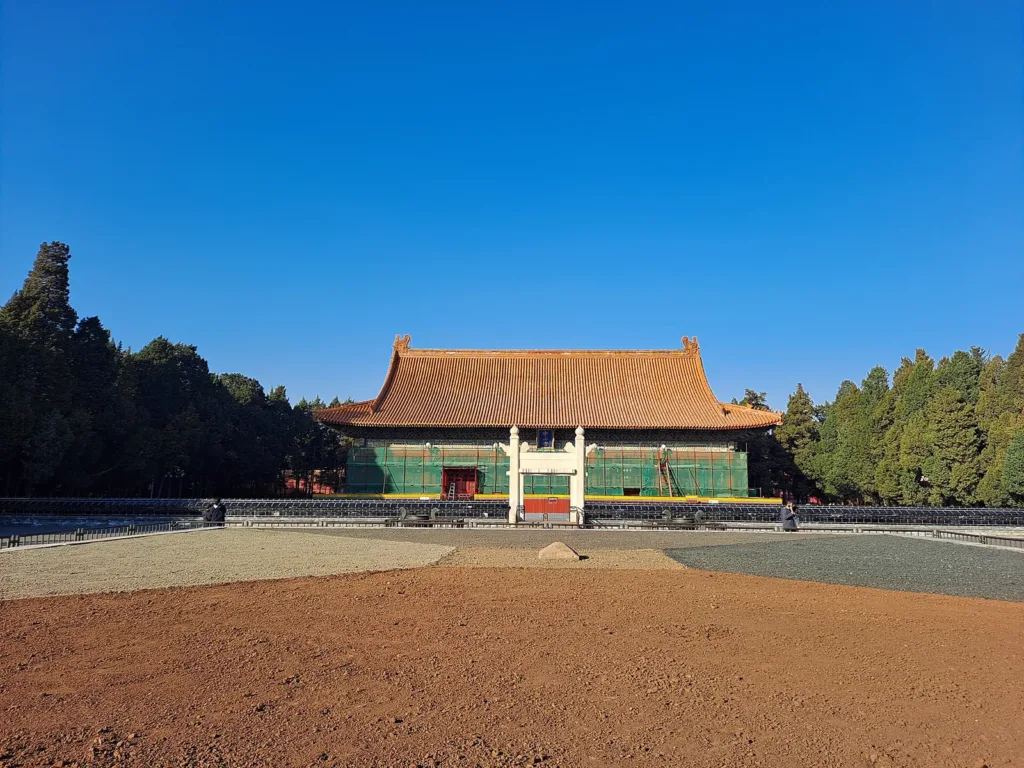
The park occupies the former site of an earlier Buddhist temple and, from 1420, the imperial Altar of Land and Grain (Sheji Tan). Emperors used the altar to make state offerings to the gods of land and grain; its purpose linked ritual with the territory and harvests of the realm. Rather than treating the site as an ordinary palace garden, look at the altar, its ceremonial setting and the surrounding historic landscape as one composition. The altar and park form part of Beijing’s Central Axis heritage.
The site opened as Central Park in 1914, the first public garden in Beijing, and was renamed Zhongshan Park in 1928 in memory of Sun Yat-sen. The former sacrificial hall, now Zhongshan Hall, is associated with the public memorial held here after Sun’s death in 1925. That layered story is the park’s distinctive appeal: imperial ritual space, early civic park and modern memorial landscape remain in the same walled precinct.
Among the features to seek out are the Sheji Altar, Zhongshan Hall, the Peace-Defending Archway, the Pavilion of the Orchid Pavilion Stele, old cypresses, and the horticultural spaces Tanghua Wu and Huifang Garden. The smaller structures and mature trees reward a slower walk between the principal historic spaces; seasonal flower displays give a different reason to return. The Central Axis conservation study stresses that the park’s significance lies not only in individual buildings but also in their surrounding setting and historic spatial sequence.
How to visit
Allow about 1–2 hours as an editorial planning suggestion for the altar, memorial hall and a relaxed garden walk; allow longer if a flower display or a separately ticketed garden is open and of interest. This is not an official tour duration. The public park is a 23.8-hectare precinct, so use the current visitor map at the gate to choose a loop rather than trying to fit every feature into a straight-line checklist.
For the simplest arrival without a Tiananmen Square reservation, use the West Gate. The park operator’s route page directs visitors from Tian’anmen West on Metro Line 1 to exit B, then via the north side of the road and the South Chang Street junction to the West Gate, about a six-minute walk. It also lists buses 1 and 52 to Tian’anmen West and bus 5 to South Chang Street, with the operator’s stated walking approaches to the same gate. Follow current security and road-control instructions on the day.
The South Gate lies within the Tiananmen Square security area. The park operator says visitors need a separate Tiananmen Square reservation and must pass its security check to reach that gate; if you do not have that reservation, use the West or East Gate instead. The operator also describes an East Gate approach through the Donghuamen area, but it is a longer cross-precinct walk rather than a direct Metro-to-gate connection.
Choose your exit before you set out. The West Gate is the straightforward return point for the Line 1 arrival described above. Use the South Gate only if your Tiananmen Square access is arranged separately. Check the park’s current map and notices for gate access and any event-related controls; do not assume the gates or surrounding roads are interchangeable.
Admission, opening and seasonal changes
The Beijing municipal park page lists the seasonal hours as follows: 6:00–21:00 from April 1 to May 31 and September 1 to October 31, with entry stopping at 20:30; 6:00–22:00 from June 1 to August 31, with entry stopping at 21:00; and 6:30–20:00 from November 1 to March 31, with entry stopping at 19:30. These are the published schedules, not a guarantee against holiday, event or temporary changes.
The regular adult park ticket is CNY 3 and the half-price ticket is CNY 1.50. The operator lists a joint ticket for Tanghua Wu and Huifang Garden at CNY 5 (half price CNY 2.50). During the spring-flower and tulip viewing season, dates varying with bloom, the operator lists a CNY 10 adult park ticket (half price CNY 5) that includes those two gardens. Verify the day’s ticket terms and whether a particular display area is open before travelling; special flower programming and garden access can change.
The park’s official website posts temporary exhibition closures and event notices, including 2026 notices concerning Huifang Garden. Check its latest notice or call 010-6605-5431 before a visit planned around a particular greenhouse, garden display or event. The park’s verified address is 4 Zhonghua Road, Dongcheng District, on Tiananmen’s west side.
Find Zhongshan Park
中山公园 · 4 Zhonghua Road, Dongcheng District, Beijing
The pin marks the area, not the entrance.
Sources & visit information
Sources checked on 21 October 2026. Hours, tickets, reservations and transport can change; confirm with the operator before you go.
- Beijing Municipal Gardening and Greening Bureau — Zhongshan Park ↗
- Beijing Municipal Cultural Relics Bureau — Study of the Overall Conservation of Sheji Altar ↗
- Zhongshan Park — Park Transport ↗
- Beijing Municipal Government — Zhongshan Park ↗
- Zhongshan Park — Ticket Prices ↗
- Zhongshan Park — Official Notices and Events ↗
- Zhongshan Park — Contact Us ↗
Image credits & notes (1)
- The Altar of Land and Grain (社稷坛) in Zhongshan Park, with the Hall of Worship behind, photographed in November 2023. Photo: EditQPhoto: CC0 1.0