

Explore the region
Tap any red Chinese text to hear it in Mandarin.
Read the wall in its landscape
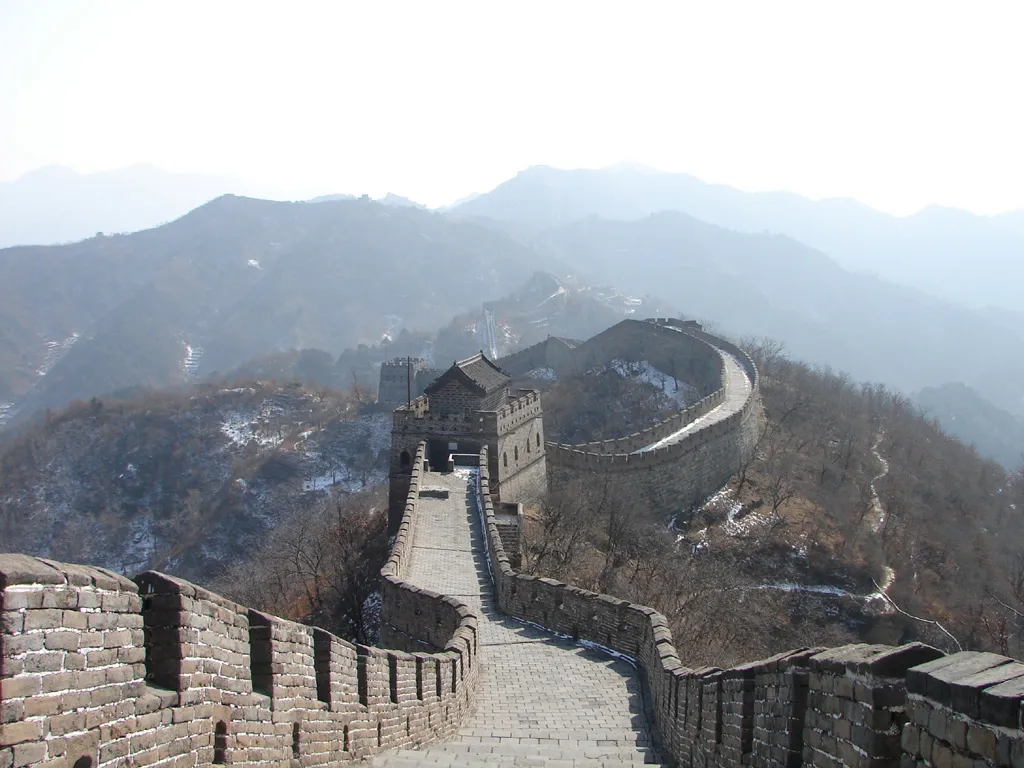
Mutianyu lies beside Mutianyu Village in Bohai Town, Huairou District, among the ridges north of Beijing’s urban core. It is not a single roadside monument: the wall climbs and bends along mountain crests, with forested slopes below and watchtowers appearing along the skyline. The Beijing municipal guide describes this section as Ming-built and notes its double-sided battlements, closely spaced towers, distinctive passes and inner and outer auxiliary walls. These features make the route legible as a defensive work adapted to steep terrain, not simply a scenic stone walkway.
The Great Wall as a whole was built and extended over many centuries. UNESCO describes it as a defence system of walls, watchtowers, shelters and passes, with construction continuing into the Ming dynasty; Mutianyu is one section within that much larger heritage landscape.
Two features worth seeking out
At the eastern end of the visitor area, Dajiaolou (大角楼, the Great Corner Tower) is named for the corner-like meeting of wall lines visible from the tower. It is a useful place to understand how the defensive line branches and turns across the ridges. Farther along the eastern stretch, Zhengguan Pass (正关台)—also called Mutianyu Pass—is a rare cluster of three hollow watchtowers standing together rather than a single gate tower. The pass dates to 1404, in the Yongle era of the Ming dynasty, according to Beijing’s official tourism guide.
The ridge walk also rewards looking closely at the parapets on both sides of the wall and at how towers punctuate bends and changes in slope. At the western end, the official scenic-area route highlights the No. 14 watchtower platform reached by cable car; beyond the visitor route, adjoining wall sections are not part of an ordinary visit. Follow barriers and current staff instructions rather than treating the continuous-looking wall as permission to keep walking.
Choose a route before buying lift tickets
The official scenic-area site recommends a lower-effort north-gate route: enter at the North Ticket Gate, take the cable car to the No. 14 watchtower viewing platform, walk the nearby ridge toward No. 15, then return by cable car from the No. 14 platform. This prioritises broad mountain views and a manageable walk without requiring a long climb on stone steps. It is an operator-published suggested route, not a promise that every wall segment or facility will be open on a particular day.
For a longer walk, spend more time exploring the open wall and towers on foot, then descend using the return option you selected at the start. The cable car, chairlift and toboggan are different facilities and do not deliver visitors to identical points; check the current station map and the ticket’s included direction before committing. The operator’s visitor advice estimates about 3–4 hours for the overall visit. That is an editorial planning range, not a guaranteed duration: stairs, crowds, weather and chosen lift connections change the pace.
The visitor centre and service plaza are at the foot of the mountain, before the wall ascent. The scenic area also identifies its Great Wall Cultural Street and restaurants near the visitor facilities; treat these as arrival or post-walk stops rather than assuming food or services are available along every ridge section.
Getting there from Beijing
Public transport is a two-stage trip, not a direct city-centre subway ride to the wall. The current Beijing municipal attraction guide directs visitors to take Express Bus 916 from Dongzhimen Public Transport Hub to Huairou Beidajie, then transfer to a local bus serving Mutianyujingqu (慕田峪景区). The municipal guide lists H23, H3 and H71; the operator’s own route page lists additional local services. Local routes and timetables can change, so confirm the live bus service and the final stop before boarding.
By car, the municipal guide directs drivers from the Jingcheng Expressway to Exit 13, Beitai Road (北台路出口), then toward Kuangou and onward by road signs to Mutianyu. Follow signs to the scenic-area parking and visitor entrance; the parking lot is not the wall-top arrival point.
Tickets, opening and booking
As checked on 21 October 2026, the operator’s website states that the 2026 peak-season schedule runs from 16 March through 15 November and that daily hours vary, including different weekday and weekend closing times. Its home page also flags special extended hours for 25 September–6 October, a period that has passed. Use the live official notice for the date of your visit rather than treating a seasonal schedule or an old article as permanent.
The operator’s current visitor advice lists a CNY 45 postcard-style admission ticket, a CNY 15 shuttle-bus ticket, and cable-car tickets at CNY 140 round trip or CNY 100 one way. These are separate products, not one all-inclusive fare. The advice also directs visitors to book online through the official channel and use an identity document for entry. Check the live official reservation screen for the available date, ticket type, eligibility discounts and current price before paying; the ticket-booking page did not expose its live inventory in readable text.
The Huairou District government’s reservation guide directs visitors to the 慕田峪长城 Mùtiányù Chángchéng official WeChat account, then to “服务” and “票务预订” to reach the ticket reservation page. Use that official route rather than assuming an old third-party listing reflects current availability.
Combine your visit
Suggested order within this visit:
-
Selected wall arrival point
Orient the route after reaching the ridge.
-
Open watchtower sequence
Compare parapets, towers, and woodland views along a manageable stretch.
-
Planned descent point
Return through the route arranged at the start rather than assuming every lift is interchangeable.
This sequence is an editorial suggestion based on the features described in the sources. Access to individual buildings or areas should be checked locally; no travel time or shared admission is implied.
Find Mutianyu Great Wall
慕田峪长城 · 怀柔区
The pin marks the area, not the entrance.
More places nearby
Approximate straight-line distances between map pins, not travel distances.
Hongluo Temple 红螺寺
9 km awayHongluo Temple stands at the southern foot of Hongluo Mountain in Huairou. Its Buddhist compound forms one part of a wider religious landscape that also includes Guanyin Temple and the Five Hundred Arhat Garden. That combination…
View guide →Yanqi Lake 雁栖湖
11 km awayYanqi Lake sits below the Yanshan Mountains in Huairou, with broad water views, a dam, and hillside paths around the conference-resort landscape. A useful visit can focus on the lake edge and the West Mountain trail rather than…
View guide →Huanghuacheng 黄花城水长城
19 km awayHuanghuacheng’s Lakeside Great Wall brings the defensive line into unusually close contact with reservoir water in Huairou. The wall follows the surrounding hills, while the lake interrupts and frames its route, including…
View guide →Sources & visit information
Sources checked on 21 October 2026. Hours, tickets, reservations and transport can change; confirm with the operator before you go.
- Beijing municipal guide to Mutianyu Great Wall ↗
- UNESCO World Heritage List: The Great Wall ↗
- Visit Beijing guide to Mutianyu watchtowers and pass ↗
- Mutianyu Great Wall official website and visitor notices ↗
- Mutianyu Great Wall operator visitor tips and ticket information ↗
- Mutianyu Great Wall operator transportation guide ↗
- Huairou District government Mutianyu ticket reservation guide ↗
Image credits & notes (1)
- A Mutianyu wall segment curves toward a watchtower above the mountain ridge. Photo: J. Samuel BurnerPhoto: CC BY 2.0