

Explore the region
A canal corridor, not one gate
Beijing (Tongzhou) Grand Canal Cultural Tourism Scenic Area follows the northern end of the Grand Canal through Tongzhou District. The Ministry of Culture and Tourism records it as a National 5A scenic area designated in 2024. Its official profile gives a length of 12.1 kilometres and an area of 7.23 square kilometres, including 2.56 square kilometres of water, and divides it into north, middle and south sections. The listed core sights include Three Temples and One Pagoda, Canal Park and Grand Canal Forest Park.
That scale matters when planning. The historic northern quarter, the central waterfront and the southern forest park are separate destinations along a long river corridor, not rooms in one compact attraction. Put the exact section or park entrance into your map before travelling; “Grand Canal scenic area” alone may route you to the wrong end. A one-day visit is usually more coherent if it concentrates on one section and adds a second only when you have arranged transport between them.
North: the old town’s temples and pagoda
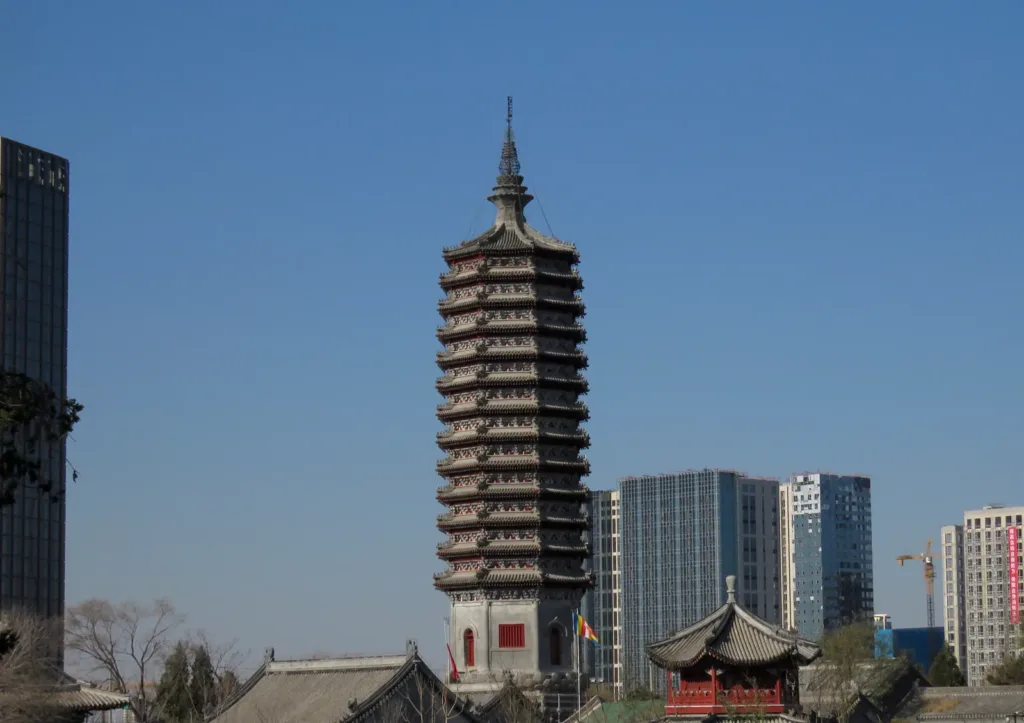
The northern section is the best place to understand why Tongzhou grew around canal traffic. Three Temples and One Pagoda brings together the Confucian Temple, Youshengjiao Temple, Ziqing Palace and Randeng Pagoda. The three religious institutions represent Confucian, Buddhist and Daoist traditions; Beijing’s municipal heritage page describes them as standing in a triangular arrangement. The group is not a single temple with interchangeable halls: look for the distinct compounds and their relationship to the pagoda above the old-town roofs.
Randeng Pagoda is an octagonal, thirteen-storey brick-and-wood landmark on the west bank of the northern Grand Canal. Beijing’s municipal government describes it as 56 metres high and traces its construction to the Northern Zhou period. The pagoda served as a landmark for people approaching Tongzhou by water; its silhouette makes more sense as a navigational sign of the canal town than as an isolated tower.
Inside the heritage quarter, displays and interpretation connect the buildings to the working waterway. A 2022 opening report describes salvaged canal timber and objects associated with river control, alongside an intangible-heritage workshop and exhibitions. Those particular activities may change, so treat them as examples of the site’s interpretive approach rather than a promise that a specific workshop or display is running on your visit.
For a first visit focused on heritage, allow about 2–3 hours as an editorial planning estimate for the temple compounds, pagoda views and any exhibits open that day. The public sources reviewed do not establish that every interior is continuously accessible; follow current on-site notices and do not assume that the pagoda itself can be climbed.
Middle: waterfront parks and canal views
The central section is more about the water and public space than about enclosed historic buildings. Canal Park combines riverside leisure, open space and water-based sightseeing. The Beijing tourism listing names sightseeing boats at Pier No. 2 and ferry crossings at the Caoyun (Grain Transport) Wharf and Liuyin Square wharves. Boat rides are separate paid services, not part of the free landscape entry.
If a boat is operating, it offers a way to read the canal as a transport landscape rather than merely as a green promenade. From the banks, look for the contrast between the broad waterway, riverside trees and Tongzhou’s newer urban development. A 2024 visitor guide reported that visitors could link sections by boat, walking, bicycle or electric cart, but that report does not guarantee every mode or route is operating now; check the current service before building a cross-area itinerary around it.
South: a longer green-space visit
Grand Canal Forest Park occupies a long stretch along both banks of the North Canal in Tongzhou. Beijing’s forestry authority describes it as a large comprehensive park extending roughly 8.6 kilometres from the vicinity of Luyang Bridge in the north to Wuyou Bridge in the south, with a sequence of six landscape areas and eighteen named scenes. Wetland vegetation, reed beds, waterside platforms and tree-lined paths make this the section for an unhurried walk, cycling where permitted, or a family outing rather than a concentrated monument visit.
The forest park is not a short stroll attached to the historic compound. Choose a specific park gate and allow 2–4 hours as an editorial estimate for a partial riverside walk; a longer outing will take more time. A 2024 guide highlights reed-bed boardwalks and the Caoyun Wharf area, but amenities and access can vary along the park’s length.
Hours, entry and paid boat services
The Beijing tourism portal’s visitor listing states that general scenic-area admission is free. It lists opening hours of 06:00–22:00, last entry 21:00, from 1 April to 31 October, and 06:00–21:00, last entry 20:00, from 1 November to 31 March. As checked on 21 October 2026, the same listing gives sightseeing-boat fares at Pier No. 2 of CNY 75 for adults and CNY 37.50 for children under 1.2 metres. It lists ferry fares at Caoyun Wharf and Liuyin Square as CNY 20 return or CNY 15 one way for adults, with half-price fares for children under 1.2 metres. These are the portal’s listed rates, not a guarantee that a specific boat or wharf is operating at a particular time; check the live listing or contact the attraction before travelling.
The official listing does not specify a current reservation rule or booking channel for every section, and no single gate or universal ticket for the entire 12.1-kilometre area is established by the sources cited here. Verify access requirements for the exact park or heritage compound you plan to visit. Public transport directions and station-exit letters are not included because the sources reviewed do not provide a dependable current route to each section; use a live map with the destination’s full name rather than navigating to the scenic area’s umbrella name.
Find Beijing Grand Canal cultural area
北京大运河文化旅游景区 · 北京 · 通州区
The pin marks the area, not the entrance.
Sources & visit information
Sources checked on 21 October 2026. Hours, tickets, reservations and transport can change; confirm with the operator before you go.
- Ministry of Culture and Tourism scenic-area profile ↗
- Beijing tourism portal visitor listing ↗
- Beijing municipal heritage page on the Randeng Pagoda and Three Temples ↗
- Beijing Daily report on the north section opening ↗
- Beijing government account of Three Temples and One Pagoda ↗
- Beijing News visitor guide to the Tongzhou Grand Canal ↗
- Beijing forestry authority profile of Grand Canal Forest Park ↗
Image credits & notes (1)
- Randeng Pagoda above the old-roofed Three Temples and One Pagoda quarter, with Tongzhou's newer sub-center skyline behind it. Photo: N509FZPhoto: CC BY-SA 4.0