

Photo adjustments
EXIF orientation normalized; resized without changing aspect ratio; converted to WebP. No subject edits.
Explore the region
About South Hot Spring
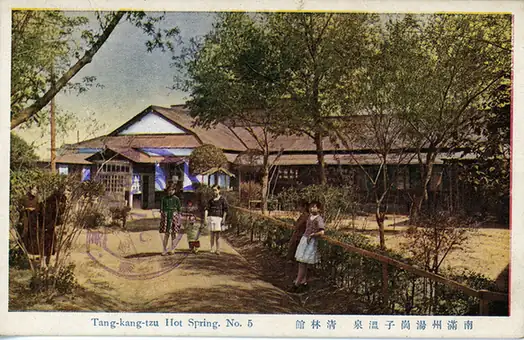
South Hot Spring (南温泉) is a hot-spring scenic area beside the Huaxi River (花溪河) in Nanquan Subdistrict (南泉街道), Banan District, roughly 18 km from central Chongqing. Its short name, Nanquan, means "southern spring" and refers to its position south of the city.
Chongqing's planning and natural resources bureau dates the discovery of the springs to the Northern Song and says local people began using them in 1577, the fifth year of the Ming Wanli reign. The scenic area took shape in the 1920s, with development starting in 1927, and received the name South Hot Spring Park (南温泉公园) in 1952. The water reaches 49°C and is classed as a low-temperature warm mineral water containing metasilicic acid and fluorine, used for therapy. Hills ring the area, pines and cypresses cover the slopes, and bamboo and willows line the stream, with waterfalls and caves among the sights.
During the War of Resistance against Japan the springs became one of the main rest places for officials of the wartime capital. Lin Sen (林森), Chiang Kai-shek and H. H. Kung (孔祥熙) all had residences built here; the dense forest around the springs made the ground hard for Japanese aircraft to observe. These houses, dating from 1938–1946, form the Nanquan Wartime Sites (南泉抗战旧址群), listed by Chongqing in 2009 and as a Major Historical and Cultural Site Protected at the National Level in the seventh batch of 2013.
The park is split into four viewing sections: the hot spring itself, Huayuan (铧园), Xiannü (仙女) and Zhushi Yuan (竹石苑). The Chongqing Stone Appreciation Museum (重庆赏石馆), set up in 1992, shows more than a thousand stones of 54 types from around China. Chongqing rates the park first-class and among its ten best scenic areas, and flower shows are held each spring and an osmanthus show each autumn.
What to look for
- The hot springs, reaching 49°C, in use since the Ming dynasty
- Lin Sen's villa, Tingquan Lou (听泉楼, "Listening to the Spring Tower"), in Huxiao Village (虎啸村)
- The former residence of H. H. Kung on Jianyu Slope (建禹山坡) inside the Nanquan forest park
- The "Principal's Residence" (校长官邸) of Chiang Kai-shek and the Bamboo Grove Villa (竹林别墅) of Chen Lifu and Chen Guofu (陈立夫、陈果夫)
- The former research department of the Central Political School (中央政治学校) in the Peng family house (彭氏民居), Baihe Village (白鹤村)
- Chongqing Stone Appreciation Museum (重庆赏石馆), with over a thousand stones of 54 types
- The Huaxi River (花溪河) and the four viewing sections, including Huayuan and Zhushi Yuan
Location & getting there
Getting to South Hot Spring
- Search for 南温泉 with 重庆市 and 巴南区.

Find South Hot Spring
南温泉 · 巴南区
No reliable map pin yet: search by the Chinese name.
Sources & visit information
Written from the linked sources and checked sentence by sentence against quoted extracts by a separate reviewer on 2026-09-23. Opening hours, admission and access arrangements are not covered; confirm current visitor information with the site.
Some facts checked against Wikipedia contributors, "重庆南温泉" · CC BY-SA 4.0.
Some facts checked against Wikipedia contributors, "南泉抗战旧址群" · CC BY-SA 4.0.