

Explore the region
Tap any red Chinese text to hear it in Mandarin.
Gongtan sits on the Chongqing bank of the Wujiang River near its meeting with the Apeng River, in Gongtan Town, Youyang Tujia and Miao Autonomous County. Across the water is Guizhou: the neighbouring bank is outside Chongqing. This is a remote county destination, not a stop in central Chongqing.
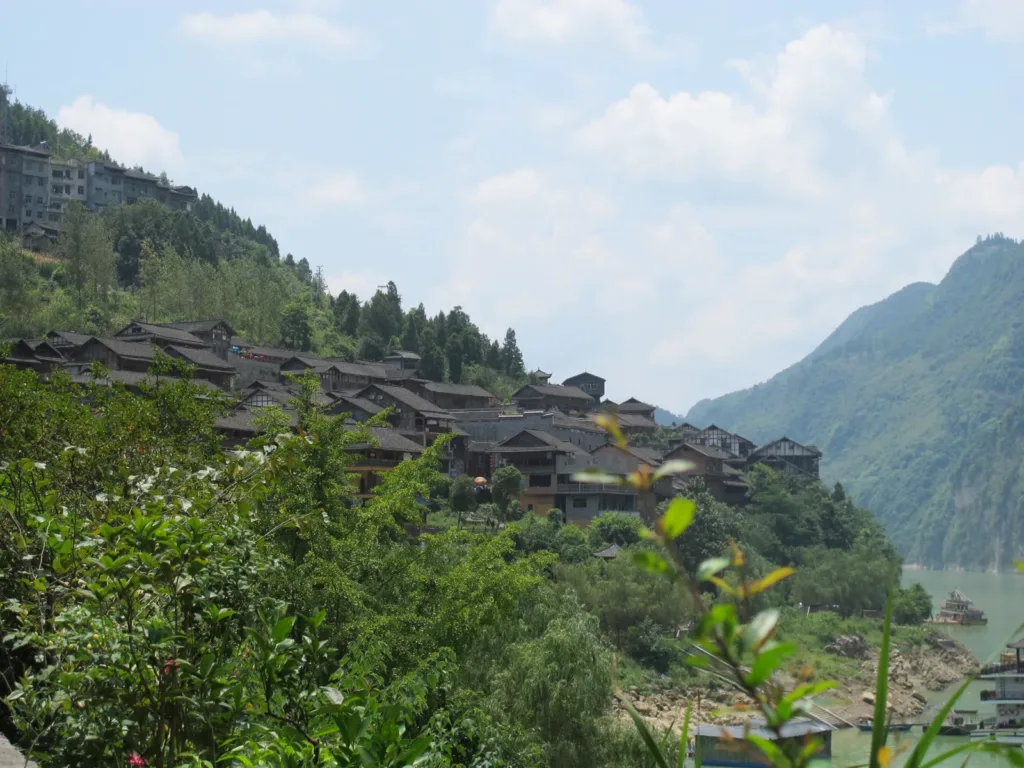
The town’s history is tied to river commerce. A dangerous stretch of the Wujiang made Gongtan a place where cargo and porters changed hands; the Qing-era Yongding Chenggui stele records rules for the labour that moved goods between boats and storage. Look for it along the stone lanes, then visit the Xiqin Guild Hall, built with the support of Shaanxi salt merchants, to see how a distant trading community left its mark on the local town. Courtyards, clan halls, small stone bridges and timber diaojiaolou (吊脚楼, stilt houses) show how homes and public buildings adapted to a steep riverside site.
What visitors see today is not an untouched surviving old town. The original settlement was moved and rebuilt downstream in 2006 during construction of the Pengshui hydropower project; the old site was submerged. The present town follows its predecessor’s layout and incorporates salvaged material. Its roughly 1.3-kilometre stone-paved street and rows of timber houses are best explored on foot: take your time with the changes in level, the small bridges and the river views between buildings.
A useful slow walk is to follow the old street from one gate to the other, pausing at the Yongding Chenggui stele, Xiqin Guild Hall, Ran family courtyard, the unusual “bridge-over-bridge” stone crossing, Chuanzhu Temple and Wenchang Pavilion. The operator also lists a Wu Guanzhong Memorial Hall and Gongtan Art Gallery, reflecting the town’s later reputation as a place for artists to sketch; check whether either indoor space is open before making it a fixed part of your visit. The scenery is part of the experience: from the built-up lanes, look across the river toward the wooded gorge, or consider a separately operated Wujiang/Apeng River sightseeing cruise. The operator describes trips on both rivers, but current sailing times, route and return arrangements must be confirmed before buying; do not treat a cruise as a dependable public ferry.
For a respectful visit, remember that the town is also a lived-in community. Stay on visitor paths, ask before entering a courtyard that appears residential, and do not photograph people or private interiors without permission. The operator describes local folk song, dance and sketching activities, but a published calendar does not establish that a performance happens on any particular day.
Getting there
Gongtan is far outside Chongqing’s metro network; no metro line or station serves the town. There is no railway station in Gongtan. The destination operator’s published route is to travel from Chongqing to Youyang or Pengshui, then transfer to a road coach for Gongtan. A 2026 People’s Daily travel feature also describes reaching Pengshui by train and continuing by minibus, while a local report gives the Youyang North Bus Station (酉阳城北汽车站)–Gongtan minibus as an onward option. These are regional connections, not a single through-ticket: check the operating station, last departure and same-day return directly with the carrier before setting out. Train schedules and coach routes can change; do not assume that Youyang Railway Station is in the county seat—it is in Longtan, away from Gongtan and the county centre.
Road travel has changed recently: the Peng-You section of the Chongqing–Hunan highway opened in early 2025, so use live routing rather than an older fixed driving-time estimate. For a car or taxi, use 龚滩古镇南门停车场 (Gongtan Ancient Town South Gate Parking Lot), in Gongtan Town, Youyang Tujia and Miao Autonomous County, Chongqing. The local visitor guide identifies the south and north gate parking areas as vehicle parking, with the riverside shuttle connecting them; the historic lanes themselves are for walking. Ask the driver to stop at the signed public parking/drop-off area rather than attempting to enter the pedestrian street. From the south gate, continue on foot along the stone-paved old street; expect slopes and steps, not a level, step-free promenade.
If you add a sightseeing boat, buy or confirm it through the official scenic-area ticket channel and ask explicitly where the boat boards, where it lands, whether the ticket returns to Gongtan, and how to get back to your accommodation or the road. The destination operator lists ticket enquiries at 023-7567-7111 and says sailing time is subject to the actual day’s arrangement; published older fares and timetables should not be treated as current.
References
Find Gongtan Ancient Town
龚滩古镇 · 酉阳土家族苗族自治县
The pin marks the area, not the entrance.
Sources & visit information
Sources checked on 22 October 2026. Hours, tickets, reservations and transport can change; confirm with the operator before you go.
Image credits & notes (1)
- Timber houses of rebuilt Gongtan climb the green hillside above the Wujiang River. Photo: 蒸蛋 (Wikimedia Commons username 蒸蛋)Photo: CC BY-SA 3.0