

Red Bean Sweet Rice Wine Drink 赤豆酒酿
Red Bean Sweet Rice Wine Drink is featured among the local specialties of Anhui.
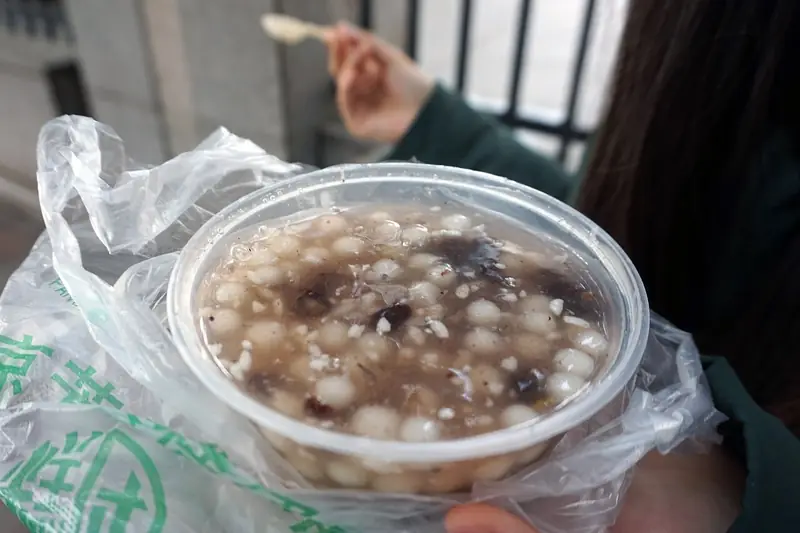

Photo adjustments
EXIF orientation normalized; resized without changing aspect ratio; converted to WebP. No subject edits.
Red Bean Sweet Rice Wine Drink (赤豆酒酿) is 芜湖's red-bean rice-wine drink — the city's summer cooler, taken iced after noodles, hotpot or cold noodles rather than as a formal dessert.
How it is made
The drink is built on 酒酿, the sweet fermented rice wine that 芜湖's official account calls 米酒 and notes was once named 醴, with red beans — 赤豆 — added to the cup. The same account describes it as simple to prepare and inexpensive, and says the iced version is what people ask for in the heat; the fermentation time, the sweetness and the proportion of beans to wine are house decisions rather than a published recipe. Some shops serve it at room temperature or warm in cold weather.
Flavour and texture
As a fermented rice drink it tastes sweet and lightly of alcohol, with the beans adding a soft, faintly mealy body and a little colour. Locals describe the effect as 甘甜解暑 — sweet and cooling — which is why it is drunk at the end of a spicy or oily meal rather than before it. The iced version is a mild, drinkable glass rather than a heavy dessert, so ordering two for a table is normal.
Local roots
赤豆酒酿 is presented as one of 芜湖's standing 名小吃 and, in many local minds, the summer 快乐水. The wine behind it has a long local claim: the official account traces 酒酿 to 米酒 and the older name 醴, and retells the story of 李白 buying wine from a Mr Ji at 酒仙坊村 in 南陵, reading the 白酒 of his poem as the rice wine brewed around 芜湖. The same tradition puts wine into cooking, with 酒酿蒸刀鱼 and 酒糟鱼 named as local dishes.
Ingredients and dietary checks
Two components define the drink: fermented rice wine (酒酿/米酒) and red beans. Because the wine is fermented from grain, this is not an alcohol-free drink, so anyone avoiding alcohol should ask 有没有酒 (does it contain wine) and treat it as containing some. Useful questions are 甜不甜 (how sweet), 红豆多一点可以吗 (more beans, please) and 是冰的还是常温的 (iced or room temperature).
How to order it
Say 一杯赤豆酒酿 or 一份赤豆酒酿, then settle temperature with 要冰的还是常温的 and sweetness with 不要太甜. It is normally drunk alongside or after the meal, so ordering it at the same time as the noodles keeps it cold; if you are sharing, ask 大杯还是小杯 (large or small). Anyone who wants it as dessert rather than a drink can simply ask 可以先上吗 or 最后上.
Drinking it and planning the meal
Drink it cold and slowly; the wine is light, so the pleasure is in the cool sweetness after something oily or spicy rather than in the alcohol. It pairs naturally with 麻辣烫, a bowl of noodles or 凉皮, which is how 芜湖 orders it, and it works equally well as the last thing on the table. If the cup is too sweet, ask for 少糖 next time, and if you liked it, 酒酿蒸刀鱼 is a way to meet the same wine in a dish.
More dishes to compare
Explore related local specialties and compare their names, preparation notes and ordering guidance.
Linhuan Tea-Stem Tea 临涣棒棒茶 →
Linhuan Tea-Stem Tea (临涣棒棒茶) is the tea of 临涣 in 淮北, served in teahouses as a slow, savoury-social drink, while 赤豆酒酿 is 芜湖's fermented rice-and-red-bean cooler; one is brewed tea taken over hours, the other a sweet iced cup taken after a meal.
Questions before you order
Does 赤豆酒酿 contain alcohol?
It is made with 酒酿, which the 芜湖 account equates with 米酒, so it does carry some alcohol. Ask 有没有酒 and 酒味重不重 if that matters.
When do people drink it?
芜湖 drinks it in summer as a cooler, typically iced and after something like 麻辣烫, noodles, 米线 or 凉皮. Ask for it iced with 要冰的 and it arrives as a drink, not a dessert.
Sources & reading
The supplied food list supports this name and regional association. The culinary terms below are explained as menu vocabulary; a local recipe, origin story and venue availability have not been independently verified.