

River Fish Head 江鲜鱼头
River Fish Head is featured among the local specialties of Anhui.
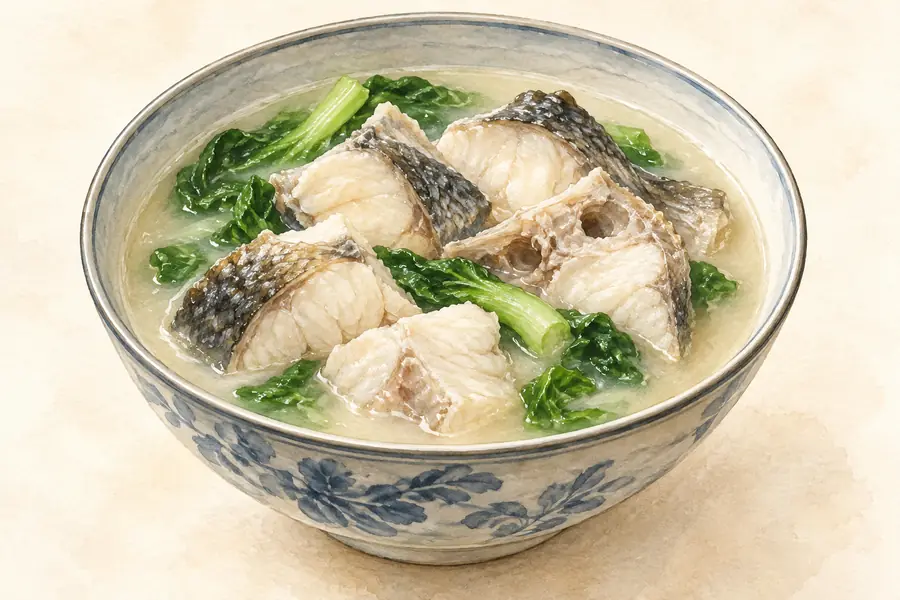
River Fish Head (江鲜鱼头) is listed among the local specialities of Tongling, Anhui. The name is plain: 鱼头 is a fish head, and 江鲜 describes freshwater fish taken from a river.
How a fish head is cooked
River fish heads are usually either steamed with aromatics, braised in soy and stock, or simmered into a milky soup, and the choice changes the dish more than the fish does. Steaming keeps the flesh delicate and puts ginger and spring onion in the foreground; braising gives the skin colour and a heavier sauce; long simmering pulls collagen out of the head and thickens the liquid.
Whatever the method, the head is split or cut into sections so the heat reaches the thick parts, and the cooking stops as soon as the flesh lifts from the bone, because a head overcooks faster than a fillet. Ask 怎么做的 (how is it cooked) before choosing, since the same name can arrive as a soup or as a plate.
Flavour and texture
Expect soft, fine flesh rather than a firm steak, plus the soft collagen around the collar, which is the part that makes a head worth ordering. Freshwater fish also carry a faint earthy note that ginger, vinegar and a little chilli are there to manage. A steamed head tastes cleanest; a braised one is saltier and richer; a soup version is the mildest and the easiest to share.
Local roots and the season
The regional list enters the dish under Tongling, a city on the lower Yangtze in Anhui, and 江鲜 as a category refers to fish from the river rather than from a pond. That is the full extent of the local information given, so no particular species, landing place or house recipe is described here.
The practical consequence is seasonality. River fish are best in the colder months, and a kitchen that works with what came in that day may use a different fish on a different week; asking which one is on the counter is more useful than expecting a fixed answer.
Ingredients and dietary needs
Fish, aromatics and a cooking liquid are the base, so this dish is not suitable if you avoid fish, and braised or souped versions may use pork stock, chicken stock or rice wine. Ask 用什么汤 (what is the stock) and 有没有放料酒, and if you avoid pork ask specifically, since a 高汤 in a Chinese kitchen is often pork- or chicken-based. Expect fine bones and shared serving spoons.
How to order it
Ask 今天有什么鱼 (what fish do you have today), then 怎么做的 (how is it cooked), 一份多大 (how big is one order) and 辣不辣 (how spicy). Useful phrases include 清蒸 (steamed), 红烧 (braised in soy), 做汤 (as a soup) and 不要放酒 (no wine). If you are eating with people who do not pick through bones, ask 有小份吗 and order a fillet dish alongside.
How to eat it and plan a meal
Start with the cheek and the meat along the jaw, which come away easily, and leave the collar and the base of the head for last, when they have softened further. Keep a plate for bones and do not rush. One head is normally a shared dish for two or three people, so pair it with rice, a green vegetable and one lighter dish rather than a second heavy braise.
More dishes to compare
Explore related local specialties and compare their names, preparation notes and ordering guidance.
Wuhe Tuohu Lake Fish Head 五河沱湖鱼头 →
Wuhe Tuohu Lake Fish Head (五河沱湖鱼头) is a fish-head dish named for Tuohu Lake in Wuhe, while 江鲜鱼头 is named for river fish as a category and is filed under Tongling. One name points to a specific lake; the other points to the river, so the useful question at either table is which fish came in today.
Questions before you order
Which fish is used?
The task does not say, and 江鲜 describes the source rather than a species. Ask 今天有什么鱼 (what fish is available today) and 是整条还是鱼头 (is it a whole fish or just the head) before ordering.
Is it difficult to eat?
It is bonier than a fillet and you will need to work around fine bones. Ask for 一个小盘 to put them on, take the cheek and jaw meat first, and order a second dish that is easy to eat if someone at the table would rather not pick through a head.
Sources & reading
The supplied food list supports this name and regional association. The culinary terms below are explained as menu vocabulary; a local recipe, origin story and venue availability have not been independently verified.