

Suzhou Sa Soup 宿州sa汤
Suzhou Sa Soup is featured among the local specialties of Anhui.
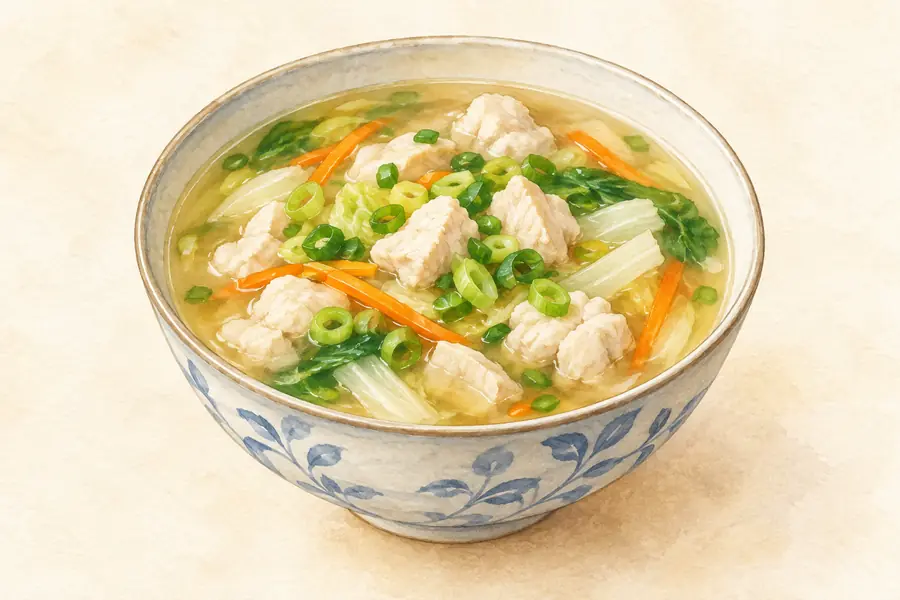
Suzhou Sa Soup (宿州sa汤) is the breakfast soup of Suzhou (宿州) in northern Anhui, not the Suzhou in Jiangsu: a raw egg is beaten in the bowl and cooked by a ladle of boiling-hot old-hen stock thickened with flour. The name is also written with a character read sà (月䪞). The soup is grouped with Fuliji roast chicken (符离集烧鸡), Dangshan pears (砀山酥梨) and Xiaoxian mutton soup (萧县羊肉汤) as the "four wonders" of Suzhou food.
How it is made
The work is in the stock. An old hen is simmered with twenty to thirty spices for about ten hours; flour mixed with water into a batter is then added and brought to the boil to make the soup base. To serve, the cook cracks a raw egg into the bowl, beats it quickly and pours the boiling stock straight onto it.
Flavour and texture
The soup looks plain and uses no costly ingredients, but it tastes salty, savoury and full-bodied. Stirred gently with chopsticks, it is fine and supple on the tongue, and it tastes of meat. Anhui News sets it apart from both the heavy broth of northwestern beef noodles and the delicate broth of Jiangnan plain noodles. It is served scalding hot, finished with a few drops of sesame oil, a little vinegar and a pinch of coriander.
How it is eaten
Suzhou Sa Soup is a standard breakfast in the city's breakfast shops, ordered with pan-fried dumplings (锅贴) or steamed buns. Going out for a bowl is an everyday habit, and Xinhua presents breaking into a sweat over it as the free and forthright outlook of northern Anhui people.
Where it comes from
Anhui News traces the soup to the pheasant broth that Peng Keng (彭铿), the legendary founding master of Chinese cooking, is said to have offered Emperor Yao. A story still told in Suzhou has the Qianlong Emperor, travelling incognito on a tour south, drink a bowl and ask "这是啥汤" ("what soup is this?"); the shopkeeper answered that it was simply called sa soup, and the legend credits the emperor with later writing the character for its name. Yongqiao District (埇桥区) named the soup a local intangible cultural heritage item in 2006; Anhui News reports that it was given the title of Anhui provincial intangible cultural heritage in December 2021. A Suzhou sa soup association was set up in 2017.
Sources & reading
Written from the linked sources and fact-checked against them on 2026-09-25. Recipes and servings vary between kitchens.