

Baijia feichangfen 白家肥肠粉
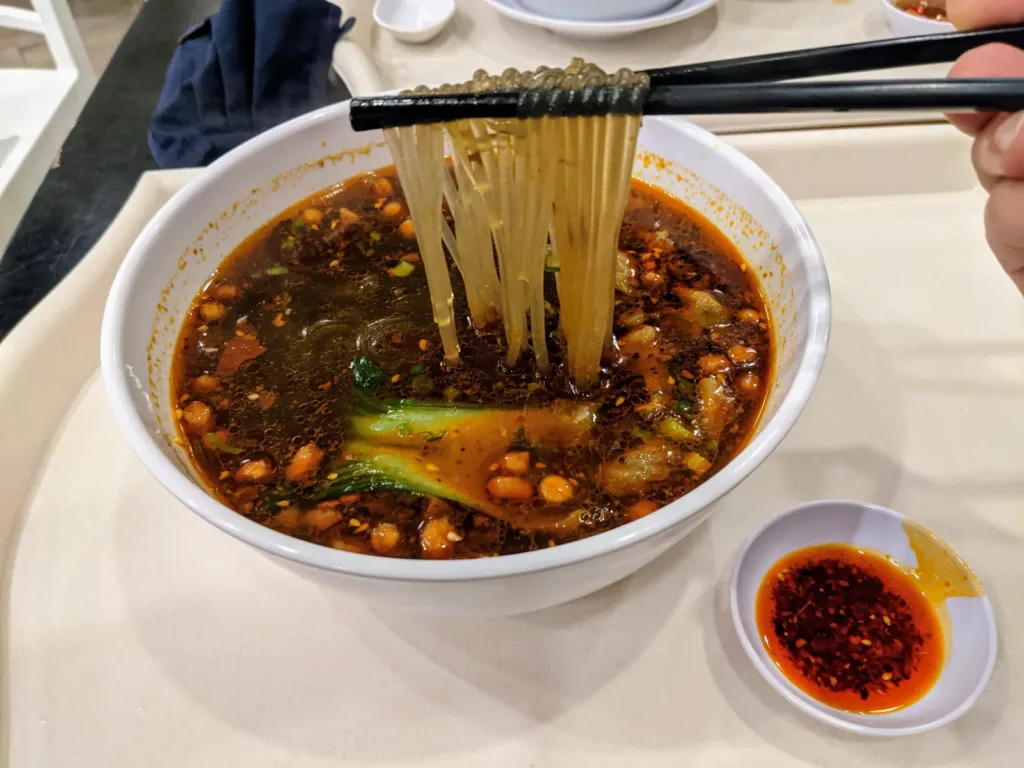
Fresh sweet-potato-starch strands meet braised pork intestine in a vivid, savory broth; the Baijia name recalls a Shuangliu food lineage, while bowls and toppings vary by shop.
Tap any red Chinese text to hear it in Mandarin.
What is in the bowl
The defining contrast is fresh, slippery-springy “fen” made mainly from sweet-potato starch and tender pork intestine. A detailed account of the Baijia Gaoji tradition describes starch batter being pressed through a perforated scoop into boiling water, then cooled; the intestines are cleaned through repeated washing and slowly braised until soft but not disintegrating. The cooked strands are briefly reheated in the broth and served with pieces of intestine.
In that account, the bowl is seasoned with soy sauce, salt, white pepper, chili oil, chopped Sichuan preserved mustard greens (芽菜), and scallions; fresh pea shoots may be blanched with the noodles. The translucent strands sit in a red-and-pale broth, with a fragrant, savory, spicy-numbing finish. Their smooth chew offsets the richer, more yielding intestine. These details describe a documented Baijia Gaoji preparation, not a fixed recipe used by every Chengdu shop. Some makers also blend other starches with sweet potato.
How to order and compare versions
Show the name 肥肠粉 féicháng fěn when ordering. Ask whether the shop offers a red chili-oil broth or a milder “original broth” (原汤), and choose the heat level you can enjoy.
Taste the broth first, then lift a few strands with some intestine so the starch’s slippery resilience, the broth’s seasoning, and the offal’s soft chew can be noticed together. Ask which intestine cut is included if you prefer a particular texture. Toppings and recipes vary between kitchens.
Baijia roots and what the name does—and does not—promise
“Baijia” refers to the historical market-town food lineage in the area now within Shuangliu District. A 2026 account in China Food traces the Gao family’s stall tradition to the Qing Guangxu period and says the Baijia Gaoji traditional technique was listed as a Shuangliu District intangible cultural heritage item in 2022. An earlier Sichuan tourism note also associates Baijia feichangfen with Baijia in Shuangliu.
Where to eat it
You can find Baijia feichangfen all over Chengdu, so there is no need to seek out one particular restaurant. To find one near you, search for “白家肥肠粉” in Meituan (美团) or Amap (高德地图) and check recent reviews, distance and opening hours.
More dishes to compare
Explore related local specialties and compare their names, preparation notes and ordering guidance.
Qionglai milk-broth noodles 奶汤面 →
Wheat noodles are served in a pale, rich meat stock, with toppings selected according to the breakfast shop. The broth's milky appearance comes from the stock preparation rather than necessarily from added dairy. The noodles are smooth and springy, surrounded by a savory, full-bodied soup. A meat topping can make the bowl more substantial.
Fuqi beef and offal slices 夫妻肺片 →
Beef and assorted beef offal are cooked, cooled and sliced thinly, then dressed with chili oil, Sichuan pepper and crushed nuts or seeds. The cuts differ by maker. The cold slices range from tender to chewy, united by a fragrant, numbing-spicy dressing and crunchy garnish.
Sources & reading
Recipes and servings vary between kitchens.
Image credits & notes (1)
- A Chengdu-style hot-and-sour noodle bowl with pork intestines, peanuts and greens; illustrative, not a documented serving from a Baijia shop. Photo: JpatokalPhoto: CC BY-SA 4.0