

Chengde naked-oat rolls 莜面窝子
Chengde’s 莜面窝子 are steamed rolls made from naked-oat flour, shaped into small hollow caps and served with savoury gravy. They are documented as a traditional Chengde-area snack and were included in a 2024 city food poll’s list of 20 local specialty snacks.
Tap any red Chinese text to hear it in Mandarin.
What to expect
莜面 (youmian) is flour made from 莜麦, a northern grain used for steamed noodles and rolls. It is not the rolled breakfast oat used in a bowl of porridge. A Chengde government food feature describes the flour as dark in colour and the local rolls as steamed, then eaten with gravy; the finished pieces are soft, smooth and slightly sticky rather than springy wheat noodles.
Related preparations can appear under names such as 莜面窝窝 (youmian wowo) or 莜面栲栳栳 (youmian kaolaolao) in English-language descriptions of northern Chinese food. In Chengde, show the local name 莜面窝子 Yóu Miàn Wō Zi when asking. Names, shapes and accompaniments vary by region and kitchen.
How it is made
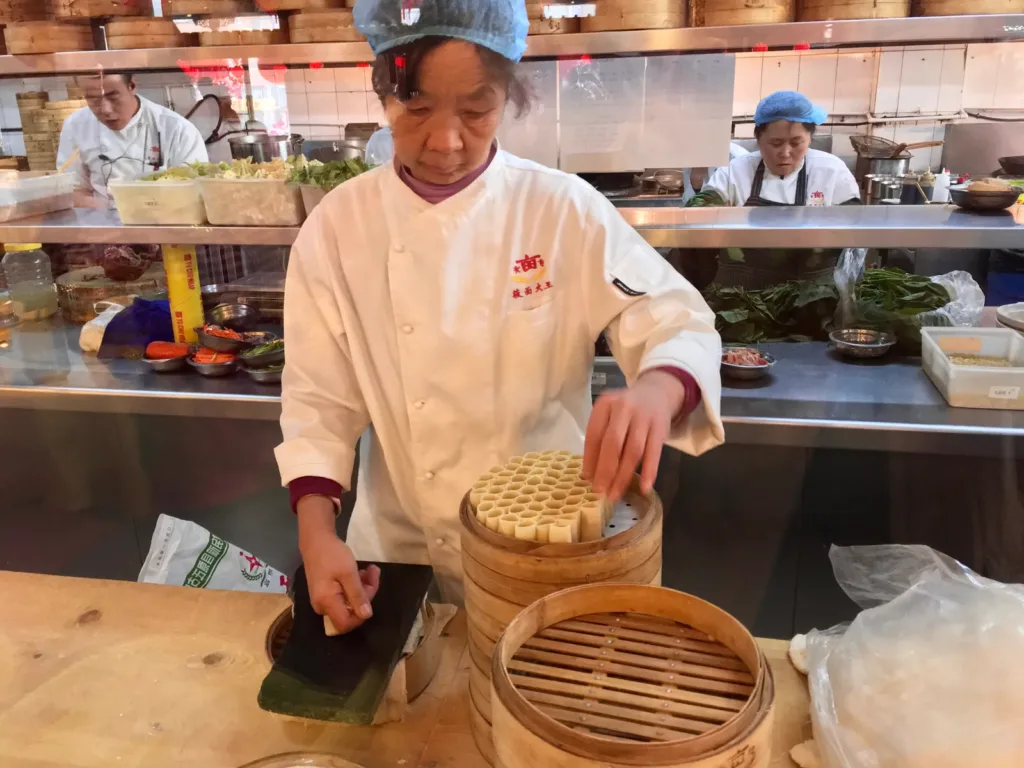
A published Chengde recipe starts by scalding 莜面 with boiling water, kneading it into a dough and letting it rest briefly. The dough is rolled out, cut into small triangular pieces, and each piece is pinched in the palm into a short, open cap before being placed upright in a steamer. After steaming, the pieces are covered with 卤 (lǔ), a savoury gravy.
That same recipe lists diced pork, chicken stock, rehydrated shiitake mushrooms and bamboo shoots, seasoned with soy sauce, cooking wine, salt, scallions and ginger. Treat this as one documented Chengde preparation, not a fixed recipe: a restaurant may use a different gravy or a simpler serving. The published ingredient list also means you should not assume that 莜面窝子 is vegetarian or free of meat stock, soy or other allergens.
The most useful thing to notice is the shaping. A small hollow piece gives the gravy somewhere to collect, so the dish is eaten as a warm grain staple with its sauce rather than as a dry roll. Take a little gravy with each piece and ask what the day’s 卤 contains if you have dietary restrictions.
Practical tips
Show 莜面窝子 Yóu Miàn Wō Zi on your phone or write it down.
Where to eat it
You can find Chengde naked-oat rolls all over Hebei, so there is no need to seek out one particular restaurant. To find one near you, search for “莜面窝子” in Meituan (美团) or Amap (高德地图) and check recent reviews, distance and opening hours.
More dishes to compare
Explore related local specialties and compare their names, preparation notes and ordering guidance.
Shenze Xihe starch-and-meat cake 深泽西河肉糕 →
Starch, meat broth and minced meat are mixed into a thick batter and steamed into a sliceable cake. Shijiazhuang's account describes mung-bean or sweet-potato starch with donkey meat and fat in the Xihe tradition. The result is smooth, savory and gently chewy, closer to a set starch cake than a pure meatloaf.
Shangyi translucent dumplings 尚义玻璃饺子 →
A thin, translucent dough wrapper is formed around a savory filling and steamed until the outline of the filling shows through. The exact dough and filling should be checked with the maker. The wrapper is supple and slightly elastic, creating a different bite from an opaque wheat dumpling. The center provides most of the seasoning and richness.
Sources & reading
Recipes and servings vary between kitchens.
Image credits & notes (1)
- A cook arranges hollow hulless-oat rolls in a bamboo steamer in a Hohhot restaurant kitchen; a regional example of the dish, not a Chengde photograph. Photo: ping linPhoto: CC BY-SA 3.0