

Chengde pine-twig steamed buns 承德松枝包子
Chengde's Songzhi baozi is a filled wheat bun in the Chengde food repertoire. Its defining detail is the use of pine twigs beneath the buns during steaming, replacing a cloth liner in the maker account; the twigs are a steaming surface rather than an edible garnish, and the filling is not one city-wide fixed recipe.
Tap any red Chinese text to hear it in Mandarin.
Chengde’s tourism authorities present 松枝包子 as one of the city’s local specialty snacks. It appears in both a Hebei tourism itinerary and a Ministry of Culture and Tourism rural-tourism route, while a Chengde government press release records it among 20 locally selected specialty snacks. These sources establish a Chengde-area food association, not a single official shop or a proven origin story.
The most recognizable part is the steamer. A 2024 profile of the Jishi brand describes using local pine twigs in place of a cloth liner and says that pine aroma meets the meat aroma of the buns under steam. That is a maker’s account of one version, not proof that every bun sold under the name uses the same twigs, filling, or seasoning.
What to look for
Look for the contrast between a hot steamed wheat wrapper and a savoury centre, with the pine material kept underneath the buns. The practical question is not whether a plate will contain visible pine: ask whether that batch was steamed on 松枝. Despite the name, the pine refers to the steaming material in the described method, not to a pine-nut pastry or an edible topping.
Fillings and seasonings are not documented here as one fixed city-wide formula. The maker profile describes the appeal through meat aroma, but it does not establish a universal meat, vegetable, stock, or spice list. If you avoid pork or other meat, eat halal, or have an allergy, ask the vendor what is in the current filling and whether the dough or seasoning contains anything you avoid; do not infer this from the appearance of the bun.
How to order
Show the name 承德松枝包子 Chéngdé Sōngzhī Bāozi. You can ask 今天是松枝蒸的吗?馅是什么? Jīn tiān shì sōngzhī zhēng de ma? xiàn shì shénme? (“Are these steamed on pine twigs today? What is the filling?”). Ask whether the price is per bun or per steamer, and open a freshly steamed bun carefully because the centre can be hot. The Chinese name is more useful than an English translation when a vendor’s menu uses a local spelling.
Where to eat it
You can find Chengde pine-twig steamed buns all over Hebei, so there is no need to seek out one particular restaurant. To find one near you, search for “承德松枝包子” in Meituan (美团) or Amap (高德地图) and check recent reviews, distance and opening hours.
More dishes to compare
Explore related local specialties and compare their names, preparation notes and ordering guidance.
Baiyunzhang-style buns 白运章包子 →
Seasoned beef or lamb is mixed with vegetables, aromatics and sesame oil, enclosed in thin wheat wrappers and steamed. The filling is worked with liquid so it stays juicy inside the pleated skin. A thin, tender wrapper surrounds a generous savory filling, with sesame fragrance and rich meat juices. The contrast is filling-led rather than bread-heavy.
Qizi shaobing 棋子烧饼 →
Small pieces of layered wheat pastry are filled, commonly with a savory meat mixture, and baked until browned. Their compact round shape gives them a resemblance to game pieces. The surface and layers are crisp and crumbly, enclosing a concentrated savory center. Sweet variants should be identified separately rather than assumed to taste the same.
Sources & reading
Recipes and servings vary between kitchens.
Image credits & notes (1)
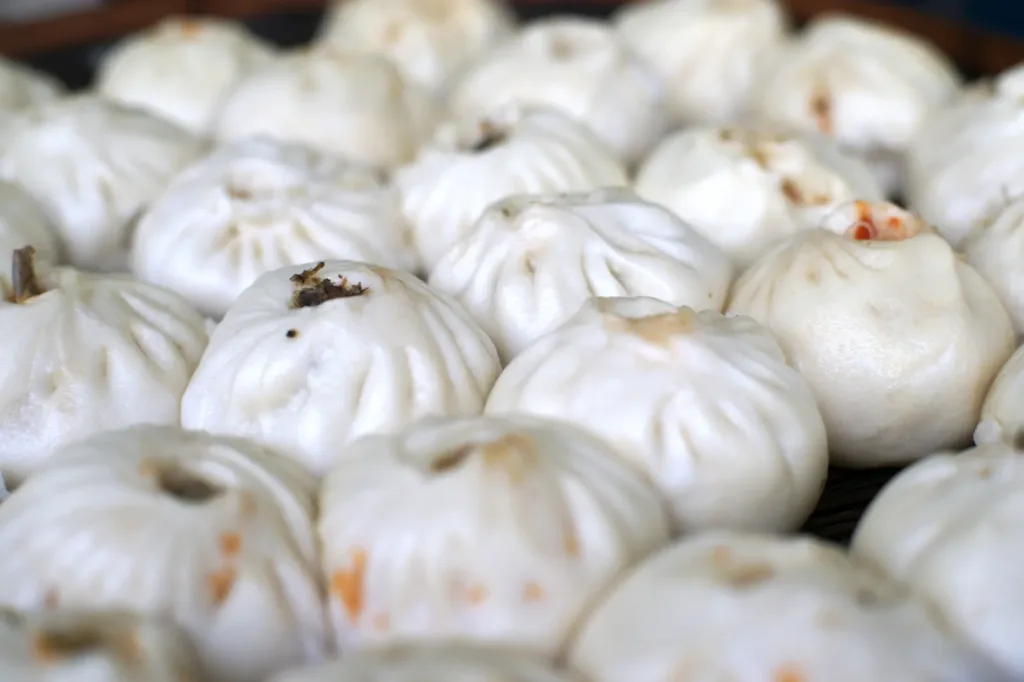
- A close view of many white filled steamed buns in Chengdu, used only as a general baozi visual reference rather than as a photograph of Chengde pine-twig bunsPhoto: Popo le Chien · CC0 1.0