

Chengdu youcha 成都油茶
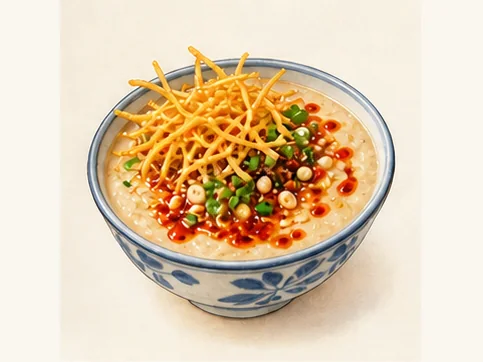
A savory Sichuan rice porridge topped with crisp fried sanzi, aromatics and often crunchy legumes; despite its name, it is not brewed tea. Recipes and toppings vary by vendor.
Tap any red Chinese text to hear it in Mandarin.
What it is
Chengdu youcha is a savory bowl built around rice cooked into a smooth, pourable-to-spoonable paste. A Chengdu food-history report quotes a Sichuan-language scholar describing the local preparation as fine rice flour simmered into a base, with crisp wheat-flour sanzi (馓子, thin fried strands) on top, fried peas beneath, and chili oil, Sichuan pepper and scallions among the seasonings. The name does not mean that the bowl is a tea drink.
How it is made and tastes
The base is stirred as rice flour or rice slurry cooks in water so it thickens without clumping. One published home-style recipe uses soaked rice with some glutinous rice, ground to flour and whisked into hot water; it describes the target as a thin, smooth porridge rather than a stiff paste. Treat that as one household method, not a fixed Chengdu formula.
The bowl is usually assembled with crisp fried sanzi and savory, aromatic toppings. Depending on the cook, these may include fried peas or soybeans, peanuts, chopped scallion, pickled mustard greens or ya cai, ginger, chili oil and ground Sichuan pepper; oil and seasoning choices vary. The mild, warm rice base lets the red chili oil, toasted or fried aromas and peppery fragrance stand out. The defining bite is the contrast between soft, lightly thick rice paste and brittle, oil-fried strands. Add toppings in stages and stir some sanzi through the bowl, leaving a few pieces dry to compare the textures.
Do not assume every bowl contains all of those garnishes, or that every shop uses the same grain ratio, oil or heat level. Ask for less chili if needed; the written dish name to show is 成都油茶 Chéngdū yóuchá. (Here, 油茶 is not a cup of tea.)
Practical tips
A 2020 Chengdu report attributes an account of Sichuan oil tea’s development from an older, peppery thick soup to a local adaptation to a scholar it interviewed. That is a reported historical interpretation, not a securely demonstrated single origin story. A separate Sichuan Daily feature documents a distinctive Peng’an sanzi paired with rice-slurry oil tea, useful as a regional comparison but not proof that Chengdu bowls use Peng’an’s particular topping.
Where to eat it
You can find Chengdu youcha all over Chengdu, so there is no need to seek out one particular restaurant. To find one near you, search for “成都油茶” in Meituan (美团) or Amap (高德地图) and check recent reviews, distance and opening hours.
More dishes to compare
Explore related local specialties and compare their names, preparation notes and ordering guidance.
Lai tangyuan 赖汤圆 →
Glutinous-rice dough is wrapped around a sweet filling and boiled until the dumplings become tender. Sesame-based fillings are familiar, with shop-specific variations in sweetness and richness. The wrapper is soft and elastic, surrounding a hot, fragrant center that can flow when bitten. Plain cooking liquid lets the filling remain the focus.
Three Cannon rice cakes 三大炮 →
Sticky-rice balls are tossed or bounced as part of a presentation, then coated in toasted soybean powder and served with brown-sugar syrup. The grain coating keeps the surface distinct from the syrup. The cakes are chewy and soft, with nutty soybean fragrance and deep sugar sweetness. Three pieces make a compact but substantial sweet.
Sources & reading
Recipes and servings vary between kitchens.