

Changshou Thin Sesame Crisps 长寿薄脆
Changshou Thin Sesame Crisps is featured among the local specialties of Chongqing.
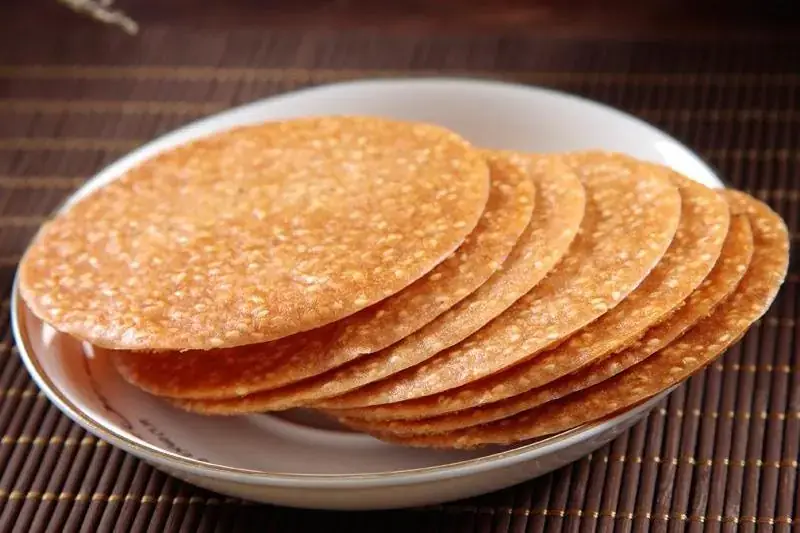
Photo adjustments
EXIF orientation normalized; resized without changing aspect ratio; converted to WebP. No subject edits.
Changshou Thin Sesame Crisps (长寿薄脆) are paper-thin wheat wafers from Changshou District (长寿区) in Chongqing, baked dry in a pan rather than deep-fried.
How it is made
Making it takes three stages. First the flour is kneaded with water until it is sticky and elastic, and the dough is left to ferment. Second, seasonings are worked in so that the finished crisp tastes clean and sweet. Third, small pieces of dough are rolled out as thin as paper and baked in a pan. The third stage is the exacting one: it needs a very low flame and constant turning so that the whole wafer heats evenly.
Baking is what sets the Changshou crisp apart from bocui made in northern China, which are mainly deep-fried, greasier and keep for a shorter time. The Changshou version uses almost no oil, stays crisp without being greasy and keeps for a long time.
Ingredients and flavour
The main ingredients are wheat flour, salt, alkali, sugar and alum; some makers also add black sesame or egg. The finished crisp is thin as paper, flaky and brittle, fragrant and sweet, and melting away in the mouth. Several food companies in Changshou make it today and have created new flavours for modern tastes.
Where it comes from
Crisp-making reached Changshou in the late Ming and early Qing with the migration known as "Huguang fills Sichuan" (湖广填四川). In the mid-Qing a Changshou man named Wang Hai (王海) reworked the method, replacing deep-frying with dry-pan baking; this removed the greasiness, made the crisp crunchier and let it keep longer.
The craft peaked in the late Qing, when many households made the crisp: wealthy families served it as a snack with tea and ordinary families took it as dry rations for work or travel. During the War of Resistance against Japan, workshops filled Sandaoguai (三倒拐) and Yushi Street (鱼市街) in the old county town, and the crisp was sold in the wartime capital, Chongqing.
After the reform era began, state food factories closed or changed products and private workshops shut one after another, and the craft came close to disappearing. The Changshou district government then protected it as an important local intangible heritage item and encouraged private food companies to keep making it, and the crisp went into Changshou gift boxes. In January 2014 the Chongqing municipal government placed Changshou crisp-making on its fourth list of municipal intangible cultural heritage items.
More dishes to compare
Explore related local specialties and compare their names, preparation notes and ordering guidance.
Hechuan walnut rice-cake slices 合川桃片 →
Both are dry Chongqing snacks given as gifts; the Changshou crisp is a wheat wafer baked thin in a pan.
Questions before you order
Are Changshou Thin Sesame Crisps fried?
No. Dry-pan baking replaced deep-frying in the mid-Qing, and the Changshou crisp is baked over a low flame with almost no oil.
Sources & reading
Written from the linked sources and checked sentence by sentence against quoted extracts by a separate reviewer on 2026-09-23. Recipes and servings vary between kitchens.