

Dachang Xuezao Sugared Rice Puffs 大昌雪枣
A snow-dusted, date-shaped confection associated with Dachang Ancient Town in Wushan County, Chongqing. Its airy rice-based centre and crisp, lightly sweet coating come from a slow process of soaking, steaming, drying, frying and sugaring—not from dates.
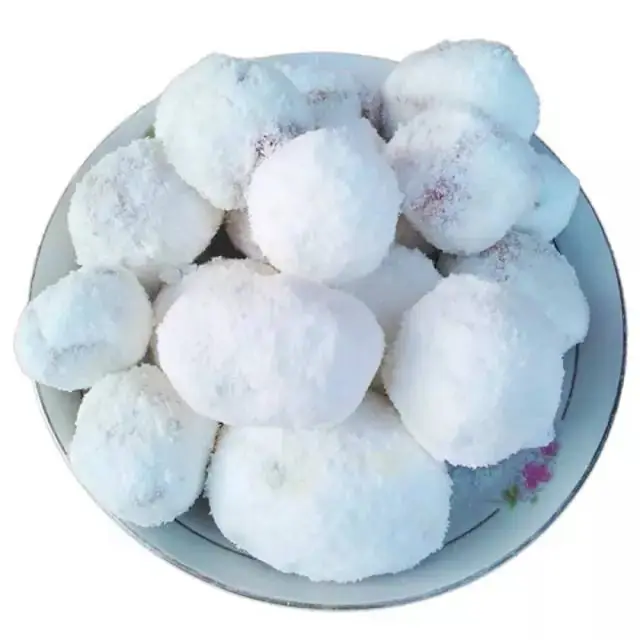
Image notes
Resized for the web; the photo itself has not been edited.
Tap any red Chinese text to hear it in Mandarin.
A Wushan confection, not a date
Dachang Xuezao is a traditional sweet linked specifically to Dachang (大昌), in Wushan County (巫山县), within Chongqing Municipality. Its date-like shape and white, frost-like coating explain the name: “snow date.” It is made from grain and sugar ingredients, not fruit, and is better understood as a local Wushan specialty than as a dish found uniformly across Chongqing.
A maker interviewed in a 2017 local feature described glutinous rice, soybeans, taro, honey and maltose in the 洪昌达 version. The 2021 Chongqing Daily account also records glutinous rice, beans, taro, maltose and honey. Ingredients and proportions can differ among makers; those reports describe particular craft accounts, not a single mandatory recipe for every batch.
How it is made and eaten
The craft takes time. In the 2017 maker interview, glutinous rice was soaked for weeks, rinsed, pounded and steamed until soft; the cooked mixture was set, cut into evenly sized pieces and air-dried into blanks. The blanks were first warmed in oil and then fried hotter so they puffed. A malt-sugar coating and a final dusting of sugar and glutinous-rice flour formed the pale outer “snow.” This is one documented workshop method, rather than a rule for every producer.
Descriptions count the handwork differently: Chongqing Daily reported nearly 20 stages for the maker it visited, while a later heritage feature groups the traditional process into more than 30. The totals depend on how individual steps are divided.
The finished pieces are pale and date-shaped, sometimes described as having eight sides. The light powder may cling to your fingers. A broken piece shows an airy, porous interior; its thin shell gives way with a crisp bite, followed by a delicate sweetness and a quick, almost melting finish. Try one slowly and notice the contrast between the dry coating and the tender, crisp centre.
The name can be rendered as 大昌雪枣 Dàchāng xuězǎo or 巫山雪枣 Wūshān xuězǎo in local references. It is a confection rather than a fixed restaurant dish, so this guide does not point to one shop, promise daily availability or prescribe a citywide recipe. If you are travelling specifically to buy it, confirm a current seller in Wushan before setting out.