

Doujuanzi Rolls 都卷子
A Pengshui snack of translucent sweet-potato-starch sheets rolled, sliced and steamed, then served warm with a fragrant, spicy-sour dressing.
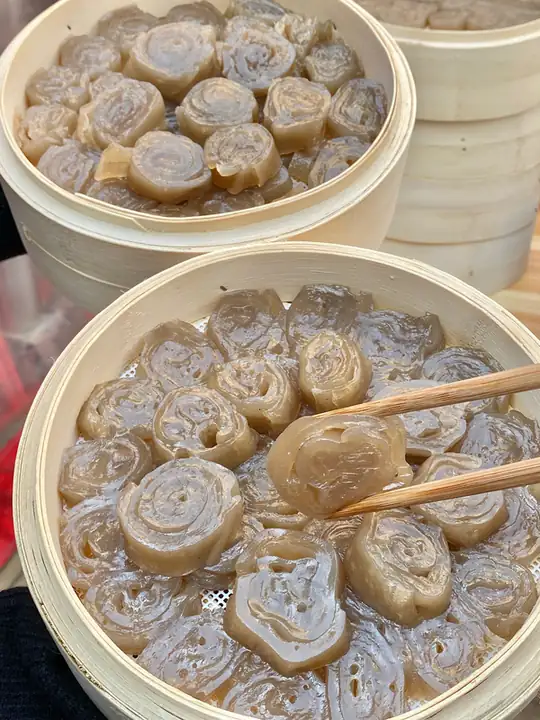
Image notes
Resized for the web; the photo itself has not been edited.
Tap any red Chinese text to hear it in Mandarin.
A Pengshui specialty
Doujuanzi (also written 嘟卷子) is identified in local sources as a traditional snack of Pengshui Miao and Tujia Autonomous County in southeastern Chongqing—not a dish established as citywide across Chongqing. The county government includes it among foods in the Miaoxiang Cookbook, and a 2025 local report describes it as part of Pengshui’s everyday food culture. Broader distribution beyond Pengshui is not established by these sources.
How it is made and tastes
A 2020 Pengshui government report documents one shop’s method: finely milled sweet-potato starch is mixed with water and repeatedly settled to remove impurities. A little rapeseed oil is heated in an iron pan; the starch mixture is poured in and the pan turned so it forms a thin round sheet. After a brief cover, the partly cooked sheet is lifted and rolled while warm. Once cooled, the roll is cut into short sections and steamed for about three minutes. This is a reported kitchen’s method, not a fixed recipe for every household or shop.
The pieces look translucent and feel soft, moist and gently chewy. They are served warm with a dressing that commonly combines soy sauce, vinegar, ground Sichuan pepper, chilli, ginger and garlic, often finished with coriander and scallion. The result is savoury and aromatic, with vinegar’s tang, chilli heat and the tingling, numbing note of pepper. A Pengshui report describes sweet-potato starch as the main ingredient and the local version as spicy-sour and fragrant; cooks and diners adjust seasoning to taste, so the balance varies.
Look for 都卷子 on menus in Pengshui rather than assuming every Chongqing restaurant serves it. If you want to ask for less seasoning, 少辣 shǎo là means “less chilli,” 少麻 shǎo má means “less numbing pepper,” and 少醋 shǎo cù means “less vinegar”; whether a kitchen can adjust the dish depends on that vendor.