

Linjiang Cured Sausage 临江香肠
A Kaizhou-listed sausage name to look for in northeastern Chongqing. Kaizhou sausage is known for cured pork, a firm bite and either numbing-spicy or savory-sweet profiles, but the exact Linjiang label has not been independently tied to one fixed recipe.
Tap any red Chinese text to hear it in Mandarin.
What the name tells you
The name 临江香肠 appears in a Chongqing food directory under Kaizhou District (开州区), which is within Chongqing Municipality. The listing does not establish whether it denotes a recipe unique to Linjiang (临江镇), a local seller’s name, or a broader Kaizhou sausage style. Reliable reporting and standards describe Kaizhou sausage generally, not a distinct Linjiang formulation, so treat the exact label as a useful menu clue rather than proof of a separate recipe.
How Kaizhou sausage is made and tastes
For the branded, district-wide “Kaizhou Sausage” product, the published technical standard specifies inspected pork from the forelegs or hind legs plus back fat, with pre-treatment, stuffing and low-temperature cold-air drying. It recognizes both numbing-spicy and savory-sweet flavor profiles. These standards describe the branded Kaizhou product; they do not prove that every item called 临江香肠 uses the same cut, seasoning or process.
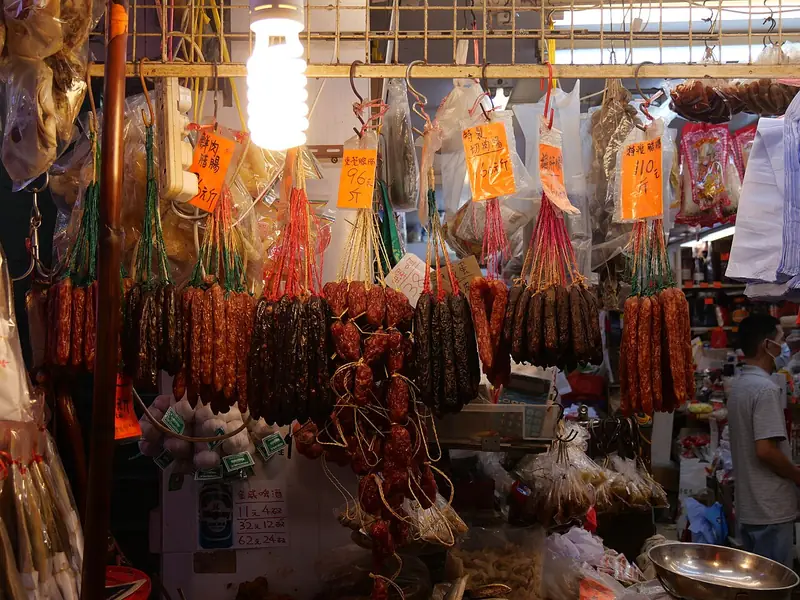
Local reporting describes the seasonal household method: stuff the seasoned meat into casings, smoke it over a wood fire, then hang it to dry under the eaves. Low-temperature fermentation is important to the aroma; modern processors use controlled low-temperature drying and airflow to reproduce some of that slower winter curing process and supply sausage beyond the cold season. Expect a red, glossy cut face with visible lean and translucent fat, a concentrated cured aroma and a substantial, chewy bite. Kaizhou’s characteristic seasoning may deliver chili heat and Sichuan-pepper numbness, while other versions lean savory-sweet.
Eating and choosing
A familiar serving is sausage steamed until hot, sliced on a plate and eaten with rice. That lets the rendered fat and cured aroma stand out without masking them in a heavy sauce. Ask whether the sausage is spicy or sweet-leaning and whether it is smoked, air-dried or a newer product style. Kaizhou producers also make variations and products for different uses; local reporting mentions additions such as ribs, sweetcorn or pork skin, as well as breakfast and hot-pot formats. Those are examples from the wider Kaizhou industry, not guaranteed ingredients or variants of the exact Linjiang-named sausage.
To compare a menu item, show the full name 临江香肠 Línjiāng xiāngcháng and ask: “这是开州临江香肠吗?是什么肉和口味?是烟熏还是风干的?” (“Is this Kaizhou Linjiang sausage? What meat and flavor is it, and is it smoked or air-dried?”). Confirm ingredients directly if you have dietary restrictions; recipes, casings, seasoning and preparation can differ by producer.
Where to eat it
You can find Linjiang Cured Sausage all over Chongqing, so there is no need to seek out one particular restaurant. To find one near you, search for “临江香肠” in Meituan (美团) or Amap (高德地图) and check recent reviews, distance and opening hours.
More dishes to compare
Explore related local specialties and compare their names, preparation notes and ordering guidance.
Cheng Kou La Xiang Chang 城口腊香肠 →
Cheng Kou La Xiang Chang (城口腊香肠) is listed among the local specialties of Chengkou County, Chongqing. 腊 describes curing.
Rongchang braised goose 荣昌卤鹅 →
Goose is braised in spiced stock and chopped into brown-skinned portions. Seek a Rongchang specialist and ask for the accompanying dipping sauce.
Chengkou smoked cured pork 城口老腊肉 →
Traditional Chengkou production uses slow smoking in a raised curing space. The cured meat is subsequently cooked and sliced or incorporated into a hot dish. The pork has a concentrated smoky aroma and a firmer bite than fresh pork. Fatty and lean cuts offer quite different textures.
Sources & reading
Image credits & notes (1)
- Reference photo of a similar dish · 同类菜品参考照片A similar preparation is pictured; the local version may differ. 同类菜品参考照片,当地做法可能不同。Photo: Peachyeung316 · CC BY-SA 4.0Resized for the web; the photo itself has not been edited. Thumbnails may show a cropped view.
