

Youyang Mawang Duck 酉阳麻旺鸭
A small local laying-duck breed from Mawang Town in Youyang County, valued as an ingredient in several regional dishes rather than one fixed recipe.
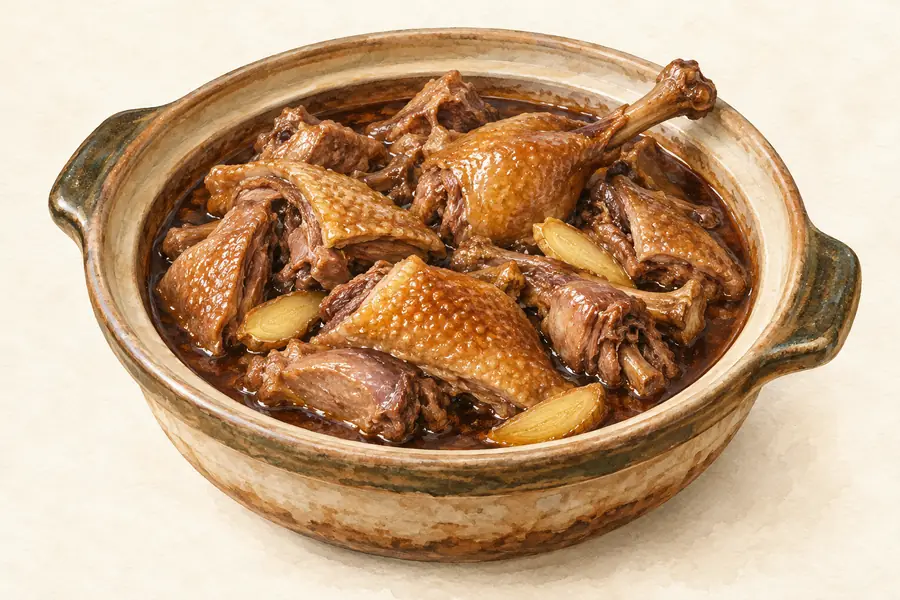
Mawang Duck is a local duck breed originating in Mawang Town, within Youyang Tujia and Miao Autonomous County in southeastern Chongqing. China’s national livestock and poultry genetic-resource catalogue lists it among the local duck breeds, and Chongqing’s agriculture authorities include it among the region’s protected livestock genetic resources. The breed’s origin is specific to Youyang; this does not make every duck dish called “konjac duck” unique to the county.
The food name can refer to the bird itself or to dishes made with it. In Youyang, one particularly well-documented preparation is pugai duck (铺盖鸭), also described as Youyang konjac duck. A 2021 report on food writer and chef Mou Zhenli, known as Ermao, traces his version to Mawang Duck paired with local highland konjac. Chongqing’s culture-and-tourism ministry also lists fragrant-braised Mawang Duck (香卤麻旺鸭) among Youyang’s specialty foods, showing that the breed appears in more than one preparation.
In Ermao’s pugai version, the konjac is made into broad, hand-sized sheets—the “coverlet” in the dish’s name. The report describes fresh konjac being ground or cut, set with lime water, then cooked with duck. In the version he recalls from his mother, the duck is cut into pieces and the konjac blanched; the seasoning is stir-fried with Sichuan pepper, chillies, pickled ginger and locally fermented chilli (酱海椒). The restaurant-style version he developed adds pork belly and uses carefully timed oils and cooking wines. Those are details of this chef’s version, not a recipe standard for every household or restaurant.
That preparation brings together springy, substantial duck meat and soft-yet-bouncy konjac that takes up the cooking juices. Ermao describes his version as savoury with a little sweetness, numbing and spicy, with a faint appetising sourness; the balance and ingredients vary by cook. Another route is fragrant-braised Mawang Duck (香卤麻旺鸭), but the ministry listing does not specify a single spice mix or method. Older ducks have also been discussed for soup and braising, but those are serving suggestions, not a claim that every Mawang Duck dish uses an aged bird.
Youyang Mawang Duck is therefore a useful local-food lens on the county’s distinctive breed and its cooks’ ingredient choices. If ordering, ask whether the dish is made with Mawang Duck (麻旺鸭) and whether the preparation is pugai / konjac duck (铺盖鸭 / 魔芋鸭); names and recipes are not interchangeable guarantees, and menus and supply vary. No particular restaurant or year-round availability is established here.