

Dalian seaweed jelly 大连海凉粉
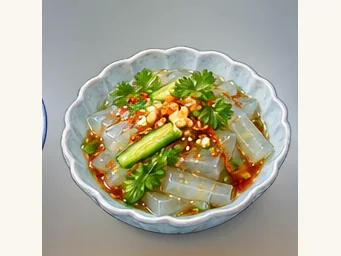
Dalian seaweed jelly (大连海凉粉, Dalian hailiangfen) is a cold local dish made by boiling coastal 牛毛菜/石花菜 until its natural gelling material sets. Cut into pieces or strips and dressed with garlic, vinegar and other variable seasonings, it is a cool, slippery side dish rooted in Dalian’s coastal everyday food culture.
Tap any red Chinese text to hear it in Mandarin.
What it is
Dalian’s seaweed jelly starts with a sea plant rather than bean or wheat starch. The Liaoning provincial commerce department describes the local raw material as 牛毛菜, also called 石花菜, growing on reefs along Dalian’s coast; it lists the dish among Liaoning’s regional snacks and describes the finished texture as tender and jelly-like.
That makes it a useful small taste of the city’s relationship with the sea, not a claim that every Dalian kitchen follows one recipe. A local Dalian food account places it among summer cooling side dishes and recalls it appearing at markets and on home tables.
How the jelly is made
Dried seaweed is washed, boiled with water, and strained; the liquid is cooled until it sets, then cut into strips or pieces. The local account gives roughly one to two hours of boiling as a home method and notes that the water-to-seaweed ratio changes the result: more water makes a softer jelly, while less makes a firmer, springier one. The setting is consistent with the wider behaviour of agar-bearing red seaweeds: hot-water extraction produces a solution that gels as it cools.
How it tastes and is served
The jelly itself is mild, cool and slippery, with a faint marine note. In Dalian, garlic, vinegar and salt are a simple starting point; household and stall versions may add soy sauce, sugar or chopped coriander. The dressing supplies much of the immediate flavour, so ask for it lightly dressed or on the side if you want to notice the jelly’s texture first.
Because the condiments and toppings vary, do not treat the dish as a fixed vegetarian or allergen-free recipe. If you avoid a particular ingredient, ask what is in the dressing before ordering.
A Dalian local-food story
The provincial list describes the dish as a traditional Dalian snack and credits chef Gai Xiyun at Bangchuidao Hotel with improving a folk preparation in the 1960s, helping it reach visitors and overseas guests. That history is best read as a story of local adaptation and presentation, not as proof that Dalian invented every form of seaweed jelly.
How to order
Show 大连海凉粉 Dàlián hǎiliángfěn or say Dalian hailiangfen. Look for it at a local food stall or restaurant when it is offered, and expect the cut, firmness and dressing to differ.
Where to eat it
You can find Dalian seaweed jelly all over Liaoning, so there is no need to seek out one particular restaurant. To find one near you, search for “大连海凉粉” in Meituan (美团) or Amap (高德地图) and check recent reviews, distance and opening hours.
More dishes to compare
Explore related local specialties and compare their names, preparation notes and ordering guidance.
Northeastern glass-noodle salad 东北大拉皮 →
The starch mixture is cooked into broad sheets, cooled and cut into ribbons. The noodles are arranged or tossed with vegetables and dressing shortly before eating, so they keep their slippery texture without becoming a uniformly soft mixture. The ribbons are smooth and elastic, while cucumber and other vegetables provide a crisp contrast. A sesame dressing feels richer; vinegar and garlic add a sharper edge. Versions differ in sweetness and chilli strength.
Liaoning sea cucumber with scallions 葱烧辽参 →
Prepared sea cucumber is braised in a savory stock enriched with cooked scallions, and the sauce is reduced to coat it. Much of the work takes place before final cooking, especially when dried sea cucumber is used. Sea cucumber contributes a springy, gelatinous texture more than a strong flavor; scallion and stock supply the aromatic depth.
Sources & reading
Recipes and servings vary between kitchens.