

Savoury Vegetable and Rice Tea Bowl 菜茶
Savoury Vegetable and Rice Tea Bowl is featured among the local specialties of Guangdong.
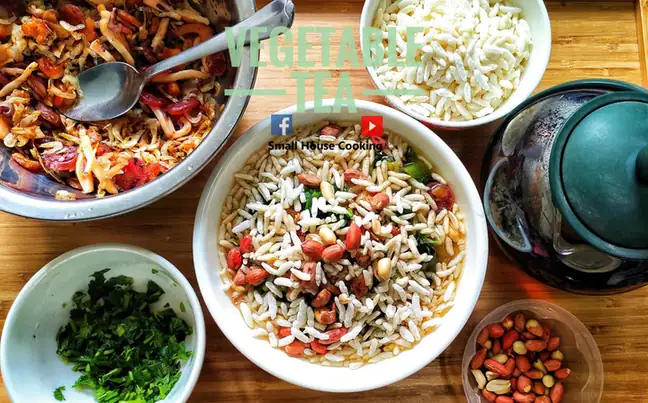
Photo adjustments
EXIF orientation normalized; resized without changing aspect ratio; converted to WebP. No subject edits.
Savoury Vegetable and Rice Tea Bowl (菜茶) is the festive 'vegetable tea' of Hailufeng (海陆丰), the Shanwei (汕尾) area of Guangdong: a bowl of stir-fried meat, seafood, beans, grains and greens, topped with peanuts and toasted rice and moistened with weak tea or pork-bone broth. It is a dish of the Hoklo (福佬) people of Haifeng (海丰), Lufeng (陆丰) and Shanwei's city district.
Ingredients
The Shanwei city government lists pork, sausage, fresh shrimp, shredded squid, glass noodles, tofu skin, white beans, red beans, wheat grains, spinach and snow peas, each stir-fried or cooked first and then mixed in the bowl. Peanuts and toasted rice (炒米) go on top, weak tea or pork-bone broth is poured over, and ground pepper seasons it. The Hakka, and people in Gongping (公平) in Haifeng and Donghai (东海) in Lufeng, also add cooked rice and call the result rice tea (饭茶).
How it is made
The vegetables, meat and seafood are cut to bite size and stir-fried together with the black-eyed beans and wheat grains. The glass noodles go in last to soak up the extra liquid, so that the bowl is not too runny. Every family keeps its own recipe.
Where it comes from
Caicha used to be made only in the first lunar month, above all around the Lantern Festival, when it was called chaoding tea (炒丁茶). A Hong Kong Commercial Daily (香港商报) column adds that, by one account, it was also known as sons' tea (男丁茶): at Spring Festival, households that had gained a son in the past year invited the neighbours in, and guests judged a family's hospitality by how rich the bowl was.
Today families make it at any time, and in Shanwei it has become common to serve caicha instead of a banquet on moving into a new home or on the third day after a wedding. It is sold on Erma Road (二马路), the arcaded old food street of central Shanwei. Large numbers of Hoklo people moved to Hong Kong between 1949 and 1970, and caicha is item 3.57 on Hong Kong's first intangible cultural heritage inventory, which describes Hailufeng and Hoklo families serving it to visiting relatives at Lunar New Year.
Sources & reading
Written from the linked sources and checked sentence by sentence against quoted extracts by a separate reviewer on 2026-09-23. Recipes and servings vary between kitchens.