

Dahao Fish Balls 达濠鱼丸
Dahao Fish Balls is featured among the local specialties of Guangdong.

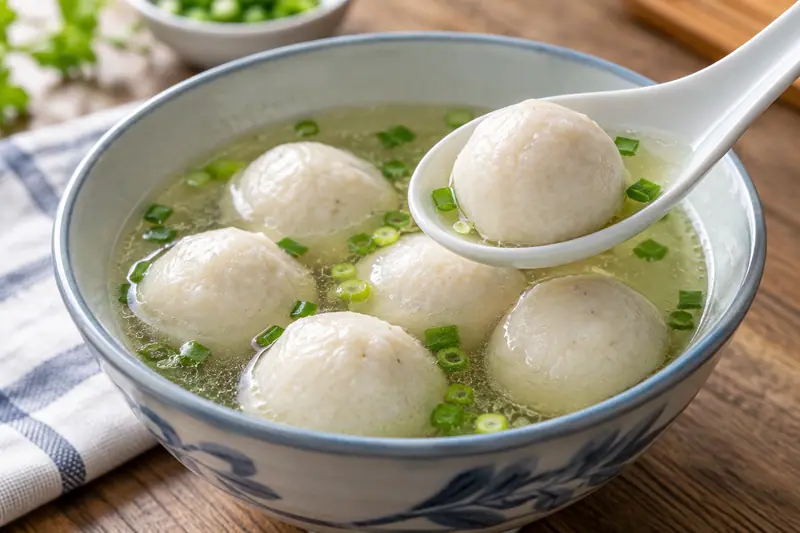
Dahao Fish Balls (达濠鱼丸) are hand-beaten balls of sea-fish paste from the old town of Dahao (达濠古镇) in Haojiang District (濠江区), Shantou (汕头). They are white, springy and crisp to the bite, and their making technique entered Guangdong's seventh list of provincial intangible cultural heritage in 2018. Nanfang Plus (南方+) calls them Haojiang's first national geographical-indication protected product.
How it is made
The Guangdong Provincial Cultural Centre (广东省文化馆) describes the method. Makers use firm, meaty sea fish landed at Haojiang's own port, such as nage fish (那哥鱼), eel and Spanish mackerel. The fish is headed, tailed, gutted and boned, and the flesh is scraped into a fine paste with a pressing knife stroke and the small bones are picked out. The paste goes into a special wooden tub with egg white, salt water, seasoning and a little starch.
The key step is slapping the paste by hand, fast and hard, until it turns gelatinous and elastic enough to cling to the palm without dropping. The maker then squeezes the paste out between thumb and forefinger into balls. They are dropped into water at 45°C to set, then boiled, lifted out and spread out to cool.
According to the centre, the springy, crisp and smooth bite comes from air pockets beaten into the paste and from protein setting in the salt water, not from chemical additives.
Where it comes from
Dahao was known in the past as Tatoubu (踏头埠), and its people farmed and fished there before the Song dynasty. Local stories about the origin of the fish balls include a Southern Song imperial cook who brought the technique south, and Qiu Hui (邱辉), an officer under Koxinga (郑成功) from Majiao (马窖) in Dahao, making them for his mother. The Shantou tax bureau quotes the founder of the Tidixiang (蒂蒂香) fish-ball shop in Haojiang, a provincial heritage bearer for the craft, as saying his family technique goes back more than 120 years.
Haojiang launched a Dahao fish ball food festival on New Year's Day 2017 and held the fourth in a row over the 2019–2020 New Year. At that festival a banquet served nage fish balls with prawn balls as 'golden double balls' (黄金双丸), a dish meant to stand for reunion because in the Teochew language the words for 'ball' and 'round' sound alike.
Sources & reading
Written from the linked sources and fact-checked against them on 2026-09-23. Recipes and servings vary between kitchens.
Image credits & notes (1)
- Reference photo of a similar dish · 同类菜品参考照片A similar preparation is pictured; the local version may differ. 同类菜品参考照片,当地做法可能不同。Photo: Alpha · CC BY-SA 2.0Resized for the web; the photo itself has not been edited. Thumbnails may show a cropped view.
