

Heshan Shangnan Roast Pork 鹤山上南烧肉
Heshan Shangnan Roast Pork is featured among the local specialties of Guangdong.
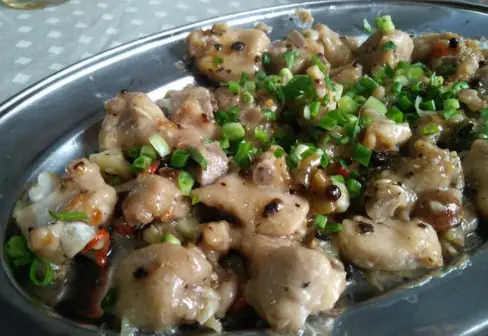
Image notes
Resized for the web; the photo itself has not been edited.
Heshan Shangnan Roast Pork (鹤山上南烧肉) is whole roast pig from Shangnan (上南) in Yayao (雅瑶), Heshan (鹤山), a city in Jiangmen (江门), Guangdong. The Heshan government notes that it comes from Yunliao market (云蓼墟) in Shangnan and is therefore also called Yunliao Roast Pork (云蓼烧肉). It is prized for crisp skin and springy meat that is not greasy, and it is a standard dish at most Heshan family banquets and often appears at ceremonies for starting new work and at offering rites.
How it is made
Roaster He Guocai (何国才), known as Yuankou (元口), describes the traditional method. A lean pig of more than 200 jin (about 100 kg) is washed, drained, boned and scored, then rubbed with five-spice powder, salt, soy sauce and, most important, minced garlic to remove the meaty smell; the Heshan government also names sugar. After about 30 minutes the skin is pricked with a sharp knife so that it does not form large blisters.
The pig hangs inside a hollow kiln about two metres high, built of earth bricks and tiles and fired with dry wood from below. A first 20-minute roast opens the pores and dries the skin; the pig is then pricked, roasted 10 minutes, pricked again, wrapped with wet or oiled paper at the ears, tail and cut edges, and roasted 30 more minutes at rising heat until the skin puffs into golden 'sesame skin' (芝麻皮). The whole roast takes about two hours, and the meat cooks from the heat of the kiln walls rather than open flame.
Flavour and texture
The Heshan literary federation says pork from an electric oven lacks the faint smoky taste of the wood-fired kiln. In 2021 only five workshops still roasted this way, mostly on hillsides far from the village.
How it is eaten
Straight from the kiln it needs no sugar or sauce; it is simply cut into small pieces. Shangnan cooks also stir-fry the pork with long beans or snow peas, braise it with taro, and boil the roasted bones in congee or in soup with dried greens. The Heshan government notes that shops sell out as soon as they open around the Qingming, Dragon Boat and Double Ninth festivals, and that visitors from Hong Kong and Macao take it home as gifts.
Where it comes from
The Heshan literary federation traces the craft to Yuan Jierong (源杰荣), called 'Second Great-Uncle' (二叔公), who learned to roast pigs at a Guangzhou slaughterhouse and brought the skill home to Shangnan in the 1940s, working from his mud house. In 1963 two fellow villagers learned from him and refined the method at the Yayao commune food station; He Guocai, who trained in the early 1990s, is counted as a third-generation Shangnan roaster. The Heshan government dates the start of production to 1965.
Sources & reading
Written from the linked sources and fact-checked against them on 2026-09-23. Recipes and servings vary between kitchens.