

Jiazi Hand-Beaten Fish Balls 甲子鱼丸
Jiazi Hand-Beaten Fish Balls is featured among the local specialties of Guangdong.

Jiazi Hand-Beaten Fish Balls (甲子鱼丸) are springy balls of pounded sea fish from Jiazi Town (甲子镇) in Lufeng (陆丰), Guangdong. Jiazi is a fishing port, and the making technique is on Lufeng's first list of intangible cultural heritage, a county-level listing.
Ingredients
Only fresh sea fish is used, never iced or frozen fish; Shanwei Daily (汕尾日报) names small eels, Spanish mackerel and sardines among the preferred kinds. Besides the fish, the balls contain only oil, salt and a little sweet-potato starch, with no other seasonings or additives.
How it is made
Shanwei Daily counts the fish balls among the most time-consuming of the Hailufeng (海陆丰) region's local foods. The fish are scaled, gutted and washed. With the skin side down on the board, the head, ribs and backbone are cut away, and the flesh is scraped off with the heel of the knife, stopping at the red layer. The scraped flesh is pounded to a pulp, mixed with sweet-potato starch in a large porcelain or wooden basin, and slapped with the palm for more than two hours until it turns into a sticky, elastic paste.
The balls are squeezed out of one hand and scooped off with a wet spoon into a basin of water. They are brought to the boil in a pot of water, lifted out and cooled in water, which leaves them springy.
How it is eaten
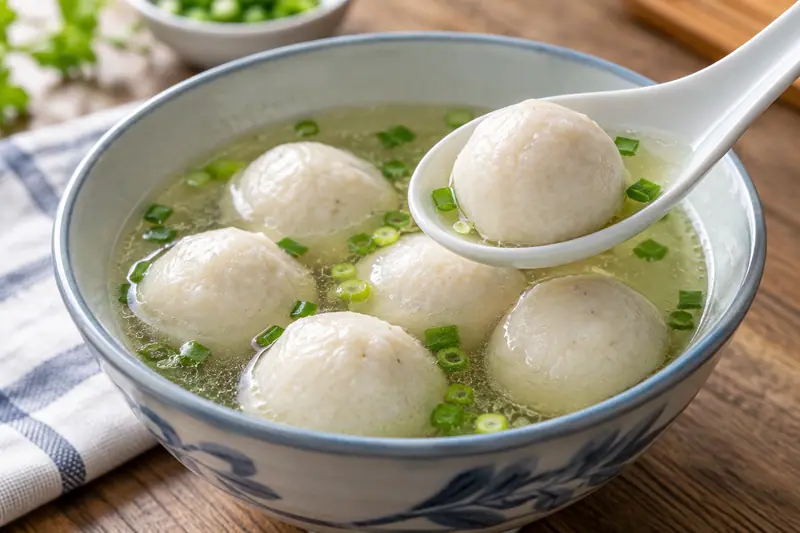
To serve, the balls are cooked in clear water or stock and finished with a little salt, a small piece of laver (紫菜) and a pinch of chopped celery, or a spoonful of spring onion fried in lard. Cooked, they are porcelain-white, bouncy and crisp without being greasy. In the early 1960s Southern Daily (南方日报) wrote that a Jiazi fish ball dropped on the floor would bounce back up onto the table, and CCTV's Weidao (味道) programme featured them in 2022 as a Lufeng speciality with a strongly elastic, chewy bite.
Where it comes from
A legend, which Shanwei Daily cites from a book on the roots of Chaozhou cuisine (潮州菜的根与史), dates the dish to 1276, when the fleeing boy emperor of the Song and the minister Lu Xiufu (陆秀夫) reached Jiazi. A fisherman's wife, afraid he would choke on bones, picked them out and beat the flesh into balls for him.
Sources & reading
Written from the linked sources and fact-checked against them on 2026-09-23. Recipes and servings vary between kitchens.
Image credits & notes (1)
- Reference photo of a similar dish · 同类菜品参考照片A similar preparation is pictured; the local version may differ. 同类菜品参考照片,当地做法可能不同。Photo: Alpha · CC BY-SA 2.0Resized for the web; the photo itself has not been edited. Thumbnails may show a cropped view.
