

Salted Buffalo Milk Slices 牛乳饼
Salted Buffalo Milk Slices is featured among the local specialties of Guangdong.
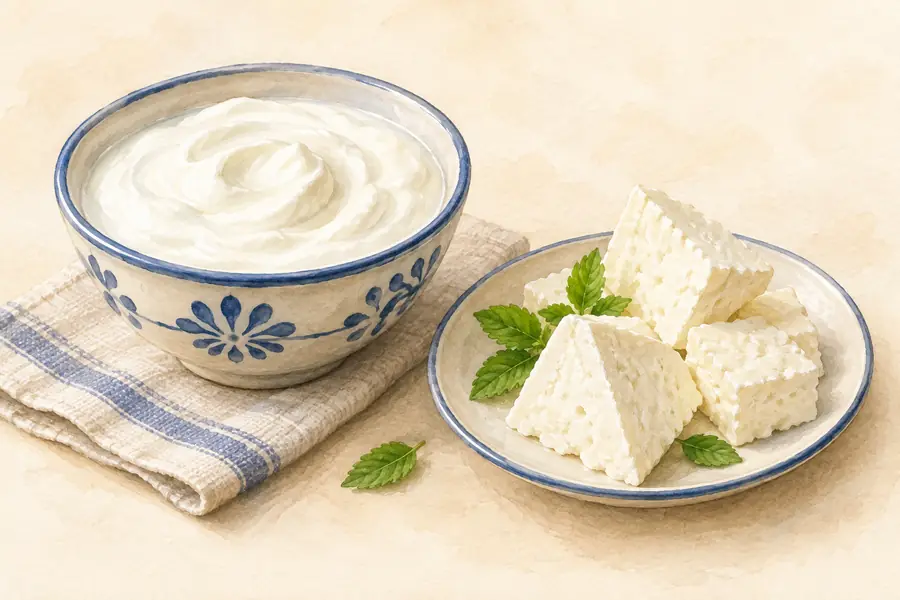
Salted Buffalo Milk Slices (牛乳饼) are thin, snow-white rounds of curdled water-buffalo milk from Shunde (顺德) in Foshan (佛山). They are made from fresh buffalo milk with coarse salt and white vinegar, taste both sweet and salty with a strong milky aroma, and have earned the nickname 'Oriental cheese' (东方芝士). Jinbang milk curd (金榜牛乳), which was once hugely popular, comes from Jinbang (金榜), in Daliang (大良) in central Shunde.
How it is made
Jinbang makers still set each slice by hand. They work with two small stoves, one burning charcoal and one without extra heat, and keep swapping two clay pots between them to hold the vinegar and the milk at the right temperatures. Milk that is too hot makes a tough curd, and milk that is too cool will not set when it meets the vinegar. Holding a small cup half full of vinegar, the maker pours in a spoonful of buffalo milk and works it with the thumb until a smooth ball of curd forms. The water is squeezed out by feel, and the curd is flicked into a round mould stamped 'Jinbang niuru' and spread flat. The slice then drops into a large clay vat of brine and needs several hours of soaking to set. Experienced makers repeat the same movement more than a thousand times a day.
How it is eaten
A bowl of plain rice congee with a slice of milk curd is a taste many Shunde people grew up with. The slices go with congee or with rice.
Where it comes from
Shunde's many waterways and rich grazing gave it a long habit of keeping water buffalo. A history of science and technology in Lingnan records a milk-curd trade in Longjiang (龙江), then part of Shunde County, by the late 16th century, which later pressed the curd into solid milk cakes sold far afield. The technique spread from Longjiang to the rest of Shunde.
Jinbang had little farmland, and villagers lived by raising water buffalo and selling the meat. Some turned to selling buffalo milk, and when fresh milk would not sell, many families made the surplus into curd. At its peak in the 1960s and 1970s the village kept more than 300 buffalo and sent its milk curd to Guangzhou, Hong Kong and Shenzhen. Buffalo keeping was later banned in Jinbang, but the hand method survives there. Jinbang milk curd making entered the seventh batch of Shunde district intangible cultural heritage items, and Jinbang now has an exhibition hall on milk-curd culture that shows the history and the full making process.
Sources & reading
Written from the linked sources and checked sentence by sentence against quoted extracts by a separate reviewer on 2026-09-23. Recipes and servings vary between kitchens.