

Roast Suckling Pig 烧乳猪
Roast Suckling Pig is featured among the local specialties of Guangdong.
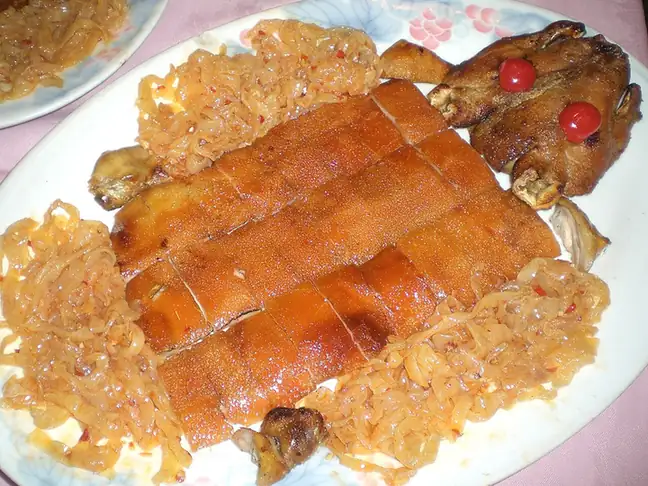

Photo adjustments
EXIF orientation normalized; resized without changing aspect ratio; converted to WebP. No subject edits.
Roast Suckling Pig (烧乳猪) is an unweaned piglet, opened up and roasted over fire until the skin is thin and crisp. It is one of the siu mei (烧味) roast meats of Guangdong, and its history there is traced back more than two thousand years, to the roasting stove and forks found in the tomb of the Nanyue king (南越王) in Guangzhou (广州).
How it is made
Chinese Wikipedia describes a piglet two to six weeks old that has not yet been weaned, usually weighing about five kilograms. After slaughter the belly is opened, the ribs are taken out, and the body is spread on a purpose-made roasting fork and roasted in an oven. Slow heat gives a smooth skin known as guangpi (光皮, 'smooth skin'); fierce heat, with oil brushed on the skin during roasting, gives a golden skin covered in small blisters, called mapi (麻皮, 'pitted skin').
In another version the cavity is packed with glutinous rice and sewn up before roasting. The rice stretches the skin thin so it crisps better, and soaks up the flavour of the pork. For the Nanyue King Banquet at Guangzhou Restaurant (广州酒家), described by the Guangzhou government portal, a raw piglet of five to six jin (about 3 kg) is filled with cured meats, shrimp and glutinous rice and roasted over charcoal.
How it is eaten
A good roast suckling pig has thin crisp skin, loose tender meat and fragrant, brittle bones. For eating it is chopped into small pieces, and because there is little meat and the skin is thin it is called sliced-skin suckling pig (片皮乳猪); a little suckling-pig sauce is sometimes added for flavour. In Guangdong and Hong Kong it remains an essential dish at wedding banquets.
Where it comes from
The tomb of the Nanyue king in Guangzhou, excavated in 1983, held a bronze roasting stove complete with chains for hanging large pieces, iron skewers, and long two- and three-pronged forks for roasting suckling pig or poultry, along with roasted pork rib bones. In the Qing dynasty the Cantonese version was chosen as one of the dishes of the Manchu-Han Imperial Feast (满汉全席).
In 2024 the Cantonese suckling pig technique (广式乳猪制作技艺) entered Yuexiu District's (越秀区) ninth list of intangible heritage, with the Dongfang Hotel (东方宾馆) as its protection unit; the hotel introduced its Cantonese suckling pig when it opened in the 1960s. In 2026 Guangzhou's ninth municipal list extended the city entry for Cantonese roast-meat making to cover roast suckling pig.
Sources & reading
Written from the linked sources and checked sentence by sentence against quoted extracts by a separate reviewer on 2026-09-23. Recipes and servings vary between kitchens.