

Shixing Zaixiang Rice Noodles 始兴宰相粉
Shixing Zaixiang Rice Noodles is featured among the local specialties of Guangdong.
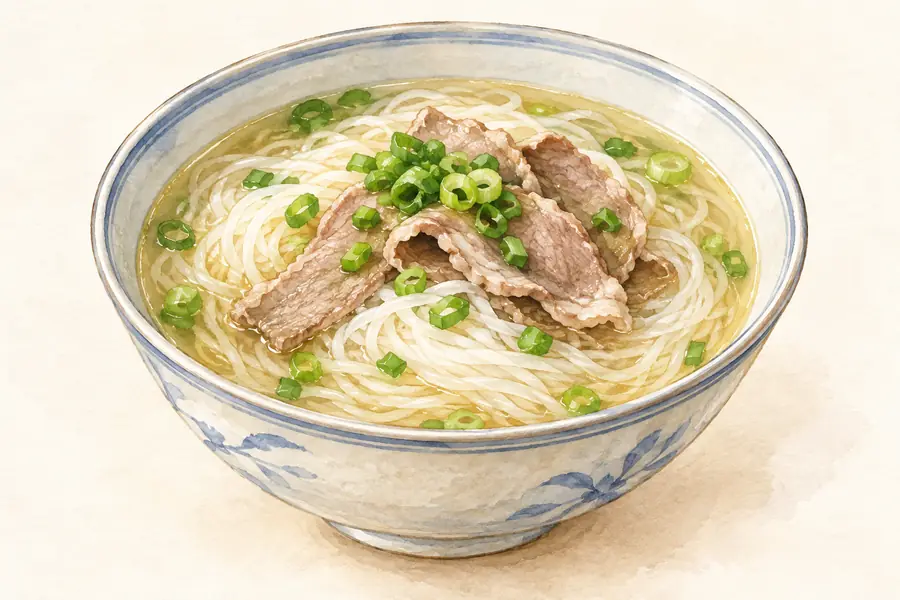
Shixing Zaixiang Rice Noodles (始兴宰相粉) are dried rice noodles from Shixing County (始兴县) in Shaoguan (韶关), northern Guangdong, cut by hand from steamed sheets of rice batter and tied into bundles. They are also called Qinghua noodles (清化粉), after Qinghua (清化), the old name of Shixing, and the "zaixiang" (宰相, chancellor) in the name refers to Zhang Jiuling (张九龄), the Tang-dynasty chancellor who came from the area.
Where it comes from
Local legend says Zhang Jiuling's mother made these noodles for him as a late-night meal while he studied, and that the name honours him. The Guangdong Cultural Center (广东省文化馆) adds that the bundles were shaped to look like the tablet an official held at court. Southcn.com (南方网), the Nanfang Daily group's news site, reports that almost every household in Aizi (隘子镇), a town in Shixing, makes the noodles, and that families still give children a bowl before an exam in the hope of success.
The making technique (宰相粉制作技艺) was entered on Guangdong's sixth provincial list of intangible cultural heritage in 2015. It is practised mainly in the Qinghua area of Shixing, and also in Wengyuan (翁源), Qujiang (曲江), Renhua (仁化) and Nanxiong (南雄). Shixing's Qinghua noodles received national geographical-indication protection at the end of 2010, the county's first product to do so.
How it is made
The heritage entry describes more than ten steps using hill-grown rice and mountain spring water. The rice is sieved and picked over, soaked in spring water for two to four hours and ground into a fine batter, traditionally on a stone mill and twice over. A thin layer of batter is poured onto a flat oiled metal tray and steamed over a high flame for a minute or two. The sheets are peeled off and dried on bamboo sieves until eight or nine tenths dry, softened again in warm water, stacked a dozen or so at a time and rolled up to rest for one to three hours. They are then cut into fine strands with a knife, pulled apart by hand, gathered into equal bundles in the tablet shape and air-dried on bamboo racks.
Flavour and texture
The noodles are known locally for staying whole when stir-fried and not turning mushy when boiled (炒而不烂、煮而不糊). The Guangdong Cultural Center describes them as glossy and translucent, springy and smooth without sticking to the teeth, even in thickness and with a clean smell. In Shixing they are deep-fried, stir-fried, braised or served in soup.
Sources & reading
Written from the linked sources and fact-checked against them on 2026-09-23. Recipes and servings vary between kitchens.