

Taro Abacus Beads 算盘子
Taro Abacus Beads is featured among the local specialties of Guangdong.
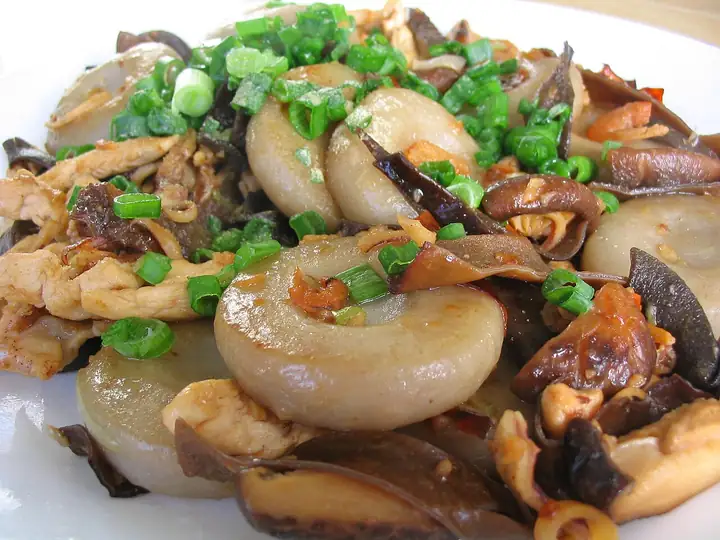

Photo adjustments
EXIF orientation normalized; resized without changing aspect ratio; converted to WebP. No subject edits.
Taro Abacus Beads (算盘子) are small discs of taro and cassava-flour dough shaped like the beads of an abacus, a long-established Hakka snack of Dabu (大埔) in Meizhou (梅州), Guangdong. Nanfang Daily (南方日报) classes them as a ban (粄), the Hakka family of dough foods, and the Ministry of Culture and Tourism lists them among Dabu's characteristic snacks.
How it is made
In a demonstration for Nanfang Daily, the Dabu cook Jiang Dekun (江德坤) peeled and sliced the taro, salted it and steamed it until very soft, then worked in cassava flour while it was still hot, adding boiling water and kneading until the dough was soft, elastic and cohesive. He keeps the water for mixing the taro and flour at 90 to 95 °C, so that the beads come out properly cooked. Each small ball is pinched between thumb and middle finger into a flat round that dips in the middle and bulges at the edges, like an abacus bead. The beads are boiled, lifted into cold water to rinse off the starch, and drained.
They are then stir-fried with lard, fish sauce, soy sauce and a mix of dried shrimp, shiitake mushrooms, minced pork and dried tofu, and finished with chopped spring onion and a little more fish sauce.
Flavour and texture
Jiang explains that soft taro and firmer cassava flour balance each other, so the beads are springy without being too chewy or too loose. Nanfang Daily found the finished dish smooth, fragrant and savoury.
How it is eaten
People thread a few beads onto a bamboo skewer to eat them, which makes them look even more like an abacus. For Hakka people, eating abacus beads stands for family togetherness and carries the wish of money to count every year. At the Lantern Festival, Meizhou Hakka families eat abacus beads along with spring onions and garlic. The words for garlic and for the dish sound like the word for abacus, and Xiao Wenping (肖文评), head of the Hakka Studies Institute at Jiaying University (嘉应学院), explains that eating either on the last day before leaving home is a wish to budget carefully and earn well while working away.
Sources & reading
Written from the linked sources and checked sentence by sentence against quoted extracts by a separate reviewer on 2026-09-23. Recipes and servings vary between kitchens.