

Tangjiawan Rice-Flour Tea Cakes 唐家湾茶果
Tangjiawan chaguo (唐家湾茶果) is not one cake but a local family of rice-flour sweets and savoury pastries from Tangjiawan in northern Zhuhai. Its distinguishing feature is the calendar: shapes, fillings and steaming or frying methods follow festivals, village customs and the ingredients of a farming-and-fishing coast. Try it as a tea snack when you find it, but do not expect one fixed daily menu.
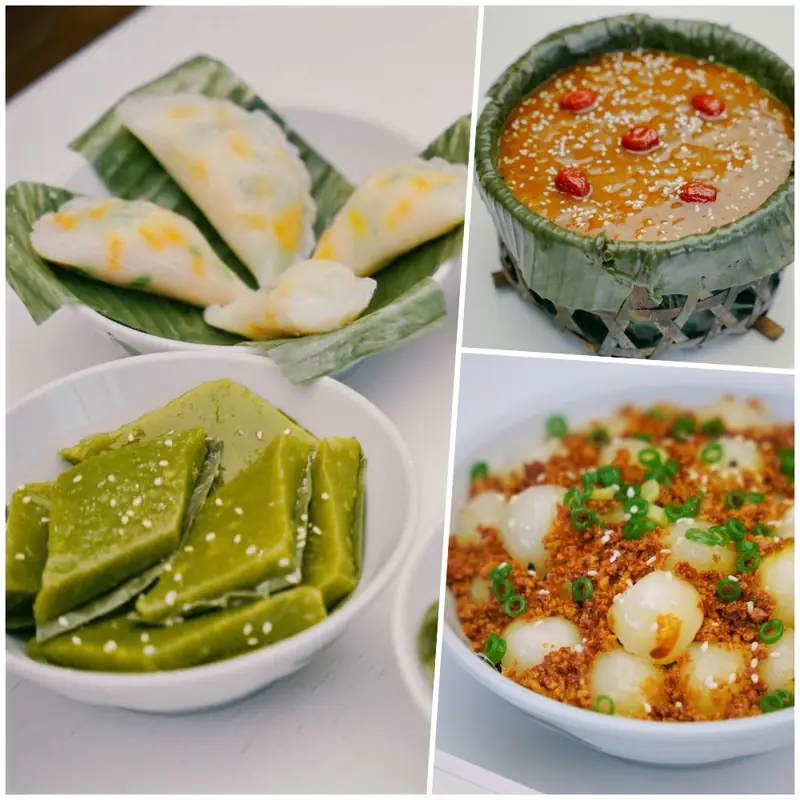
Image notes
Resized for the web; the photo itself has not been edited.
Tap any red Chinese text to hear it in Mandarin.
What “chaguo” means here
In Tangjiawan, chaguo is the everyday local word for cakes and pastries. The surviving repertoire includes dozens of forms, from the thick New Year big dragon cake (大龙糕) and boiled doulao (豆捞) to banana-leaf-wrapped yezai (叶仔), jianzui (煎堆), fried sugar rings (炸糖环), taro cake and turnip cake. The name therefore describes a regional food tradition rather than a single recipe or guaranteed shop product. Tangjiawan chaguo was listed as a Zhuhai municipal representative intangible cultural heritage item in 2010.
The tradition is closely tied to the local calendar. Local accounts describe chaguo as food once prepared for offerings and festival days, with different occasions calling for different shapes. Tangjiawan’s setting between hills, fields and the sea also matters: the heritage description connects its ingredients and customs with both Lingnan farm life and shallow-sea fishing. In modern life, the same family of foods is also eaten as an ordinary snack and with Cantonese morning tea.
Three forms worth asking about
Big dragon cake (大龙糕) is a thick New Year cake. Glutinous rice flour is mixed with brown-sugar water and a little peanut oil, poured into a steamer lined with banana leaves, and steamed over a strong flame. It is traditionally made before Lunar New Year and kept until Tangjiawan’s second-day “opening of the year”, when the old food becomes a wish for surplus in the new year. Expect a soft, dense slice with brown-sugar fragrance rather than a crisp pastry.
Doulao (豆捞) is made by rolling glutinous-rice dough into small balls, boiling them in water, then serving them with sugar and roasted peanuts. The Cantonese sound of lao suggests “bringing in money”, which explains the New Year association. It is a simple preparation, but the contrast between a tender, chewy ball and the dry crunch of peanut is the point.
Yezai (叶仔) uses hot water to bring the rice-flour dough together. A small piece is pressed thin, filled, pinched into a round parcel, wrapped in a banana leaf that has been scalded and oiled, and steamed. Savoury versions may contain peanuts, dried shrimp, pork and spring onion; sweet versions commonly use red-bean paste. Ask which filling was made that day: sweetness, saltiness and the balance of chew to filling vary between makers.
Practical tips
Treat “唐家湾茶果” as a food tradition and ask at a local market, tea-house or cultural activity what is available that day. A useful question is 今天有什么茶果? Jīntiān yǒu shénme cháguǒ? (“Which chaguo are available today?”). Festival and community demonstrations may show the preparation more clearly than an ordinary visit, but their dates and access are event-specific rather than daily promises.
Do not assume that a pale or leaf-wrapped piece is vegetarian or free of allergens. Savoury versions can contain pork, dried shrimp or peanuts, and sweet versions may still be prepared in a kitchen handling nuts. Tell the seller about allergies before ordering and ask about the specific batch.
Where to eat it
You can find Tangjiawan chaguo all over Guangdong, so there is no need to seek out one particular restaurant. To find one near you, search for “唐家湾茶果” in Meituan (美团) or Amap (高德地图) and check recent reviews, distance and opening hours.