

Wanjiang Dried Tofu Skin 万江腐竹
Wanjiang Dried Tofu Skin is featured among the local specialties of Guangdong.
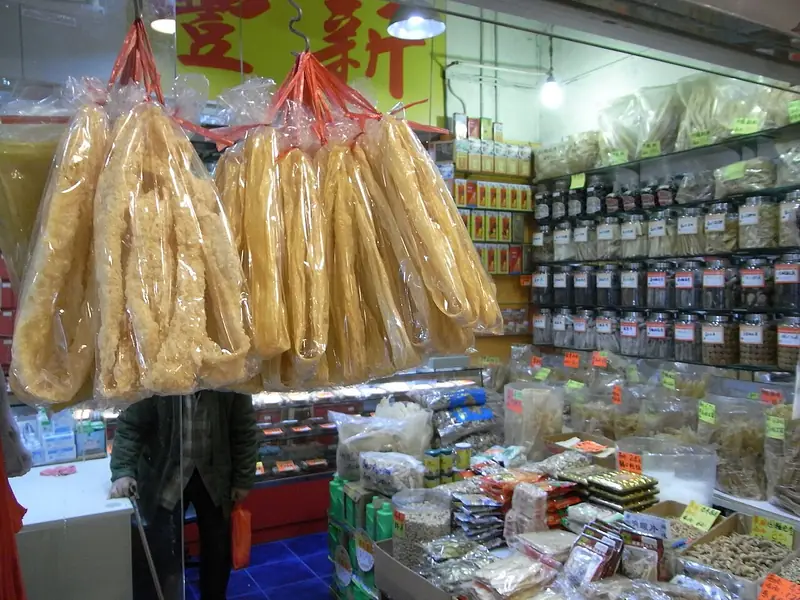
Wanjiang Dried Tofu Skin (万江腐竹) is the dried bean-curd skin, rolled into sticks, made in Wanjiang (万江), a subdistrict of Dongguan (东莞) in Guangdong. Southern Plus describes it as a traditional Dongguan food with more than 1,500 years of history. Its best-known home is Xincun (新村) village, where the Xincun tofu skin making technique became a Dongguan municipal intangible cultural heritage item in 2014.
Where it comes from
According to Southern Plus, tofu skin was first made in Wanjiang's Yongtai (永泰) village, then in Xincun, and later spread to Xicun (细村), Boxia (博厦) and Shuishechong (水蛇涌) in the old town of Guancheng (莞城). Xincun was once known far and wide as a tofu-skin village, and at its peak about 70 percent of its households made it. A Xincun villager told Dongguan Time that other towns also made tofu skin, but because Wanjiang lies along the river its product was easier to ship out, and so Guangzhou and Hong Kong came to know the name. Few workshops still make it; one family in Xincun is now in its fourth and fifth generations of makers.
How it is made
The hand process runs from grinding the soybeans and straining the milk to boiling it, letting a film form on the surface, lifting the film, drying it in the air, softening it again, straightening it and drying it in the sun before packing. In the Xincun family workshop the day starts at 1 a.m., and once the pans are lit the work runs without a break for more than ten hours, until every stick hangs on the bamboo poles. The maker cuts each sheet of film in two with a small knife, turns each half by hand into a column and hangs it on a pole. The Senji (森记) workshop in Xincun is framed with open, unglazed wooden windows so that cross-draughts of cold late-night air set the skin faster; before electric fans, that draught was the only tool for it.
How it is eaten
In Cantonese the word for tofu skin sounds like the word for 'plenty', so Dongguan people eat it at festivals for good fortune. For Dongguan Time, tofu skin in soy milk is the dish that comes to mind first when Xincun food is mentioned. At the Senji workshop the maker lifts a round of skin from the pan and pours it into a bowl with a ladle of thick soy milk. Dongguan Time describes it as rich and sticky, with a bean aroma.
Sources & reading
Written from the linked sources and fact-checked against them on 2026-09-23. Recipes and servings vary between kitchens.
Image credits & notes (1)
- Reference photo of a similar dish · 同类菜品参考照片A similar preparation is pictured; the local version may differ. 同类菜品参考照片,当地做法可能不同。Photo: Scoictho · CC BY-SA 3.0Resized for the web; the photo itself has not been edited. Thumbnails may show a cropped view.
