

Weijiao Steamed Rice Cakes 味酵粄
Weijiao Steamed Rice Cakes is featured among the local specialties of Guangdong.
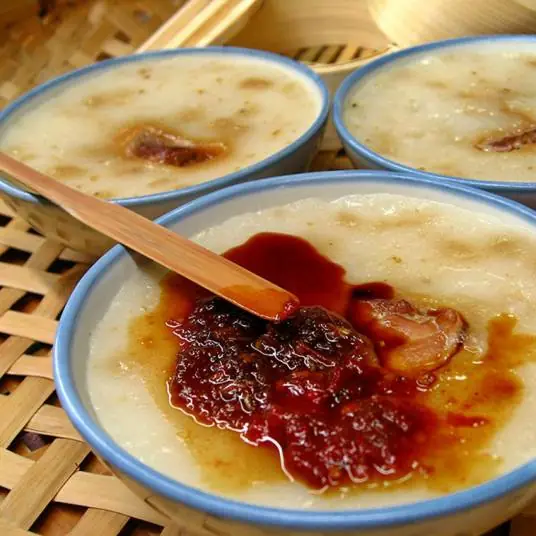
Image notes
Resized for the web; the photo itself has not been edited.
Weijiao Steamed Rice Cakes (味酵粄) are a traditional Hakka (客家) snack of Meizhou (梅州), Guangdong: small bowls of rice batter mixed with alkaline water and steamed until the edges puff up and the centre sinks into a hollow. The hollow takes a sweet soy dressing. Some hold that the name should be written with different characters for 'weijiao' (味窖粄), or that it is really migao ban (米膏粄), 'rice-paste cake'.
How it is made
Good non-glutinous rice is ground into a batter and mixed with a small amount of food alkali (lye water). Boiling water is poured into the batter, which is then ladled into small bowls and steamed. As it cooks, the surface swells around the rim and sinks in the middle into a small well. The texture is soft but chewy and springy.
How it is eaten
It is eaten dipped in 'red flavour' (红味), a sweet soy sauce poured into the hollow; Chinese Wikipedia notes that some eat it with honey instead. It can also be sliced and pan-fried, when it turns savoury, or cut into pieces and stir-fried with spring onion, garlic, diced meat and pepper, which makes it fragrant, chewy and smooth.
Where it comes from
In Hakka villages there is a custom summed up as 'grinding weijiao ban on the sixth of the sixth month': on the sixth day of the sixth lunar month, when the early rice is harvested, households turn the new rice into these cakes to celebrate the harvest. According to the national local-chronicles office site, the original name was migao ban. The earliest version is said to have been made by cutting rice ears ten to fifteen days before they were ready for harvest and grinding them straight on a stone mill, when the grain inside had thickened to a paste but not yet hardened. This was a way of staving off hunger in lean years, and over many years it developed into a snack now found in streets and lanes across Meizhou.
Sources & reading
Written from the linked sources and fact-checked against them on 2026-09-23. Recipes and servings vary between kitchens.