

Wuchuan Broken-Wok Fried Rice Noodles 吴川烂镬炒粉
Wuchuan Broken-Wok Fried Rice Noodles is featured among the local specialties of Guangdong.

Photo adjustments
EXIF orientation normalized; resized without changing aspect ratio; converted to WebP. No subject edits.
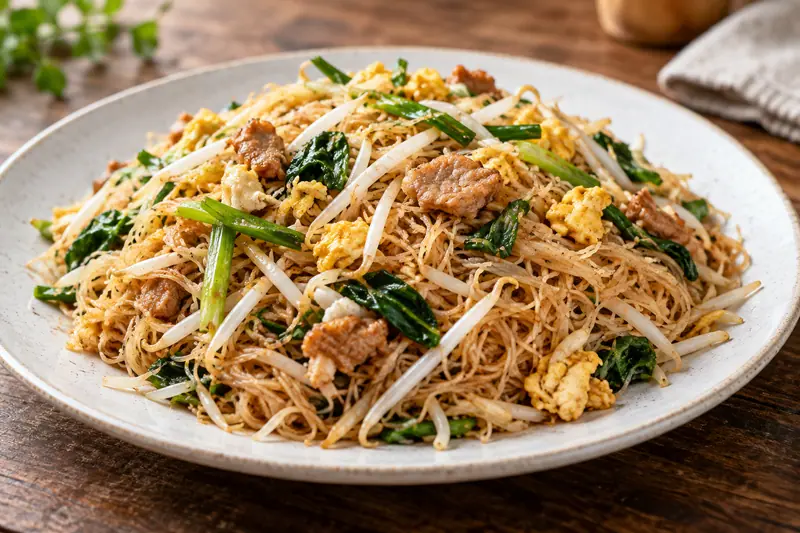
Wuchuan Broken-Wok Fried Rice Noodles (吴川烂镬炒粉) are fresh rice noodles stir-fried with roast pork and seafood in a specially altered iron wok. The Wuchuan (吴川) city government places the dish in Powei village (坡尾村) in Meilu subdistrict (梅菉街道), Zhanjiang (湛江), and says it was already being made in the Ming and Qing periods. The name comes from the wok: a large iron wok has its handles knocked off and its rim trimmed down, which leaves a flat base that heats evenly over a strong fire.
How it is made
The noodles are made first. Good white rice is soaked for a time that changes with the season and temperature, and ground into a paste; the Wuchuan government adds that the water is drawn from the village well. The paste is steamed in a thin layer over a hot fire, and the sheets are cut into fine, even strands.
At the wok, the cook heats it red, rinses it with oil and water, then adds lard. Chopped garlic, roast pork and shrimp are flash-fried before the noodles, already mixed with dark soy sauce, go in and are spread flat across the wide, shallow wok. More lard is added as they are turned, and the white noodles slowly brown in the smoke. The Wuchuan government's version also lists sugar among the seasonings and ends with a slow fire to toast the noodles yellow. Chopped spring onion or coriander goes on last, and the whole plate takes only a few minutes.
Flavour and texture
Straight from the wok the noodles carry a strong wok aroma, with the smell of oil, spring onion and garlic. The Zhanjiang Daily describes them as fragrant and oily without being greasy, and stresses that the rice noodles must be thin and fine for the right texture.
Where it comes from
Powei is known in Wuchuan as a village of noodle frying: more than 300 of its people work making fresh rice noodles or frying them, and many of the fresh rice noodles used by Zhanjiang's large restaurants come from there. A local story told by the Zhanjiang Daily traces the dish to an old noodle seller of Powei who left his four sons a single iron wok and told them to break it into four pieces; each son sold fried noodles from his broken piece, and the name spread. The dish has won the titles 'Ten Gold-Medal Snacks' and 'Most Popular Snack' at Zhanjiang food festivals and counts among the 'Ten Calling Cards of Wuchuan'.
How it is eaten
In Wuchuan the noodles can be had at any hour of the day or night; people walk out in slippers and order a plate at the roadside.
Sources & reading
Written from the linked sources and checked sentence by sentence against quoted extracts by a separate reviewer on 2026-09-23. Recipes and servings vary between kitchens.