

Salt-Baked Chicken 盐焗鸡
Salt-Baked Chicken is featured among the local specialties of Guangdong.
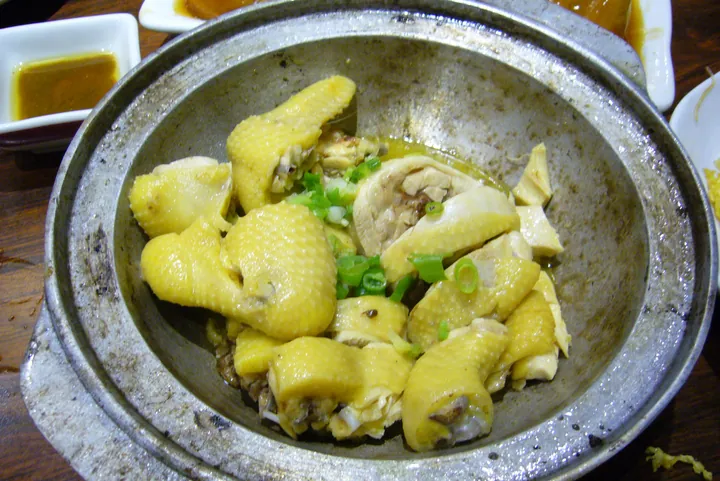

Photo adjustments
Full frame retained; proportionally resized and converted to WebP. No retouching or changes to the photographed subject. Card displays may crop the view.
Salt-Baked Chicken (盐焗鸡) is a whole chicken cooked buried in hot sea salt, and in Huizhou (惠州), on the Dongjiang (东江) or East River in Guangdong, it counts as one of the city's "three treasures" (惠州三宝). Yangcheng Evening News (羊城晚报) cites historical records giving it close to 300 years of history in Huizhou, and finds it on the tables of Hakka restaurants across the city. Its traditional qualities are summed up as crisp skin, smooth flesh and fragrant bones ("皮脆、肉滑、骨香").
How it is made
Dongjiang chef Li Hongkun (李宏坤) describes the traditional method. The bird is a hen of 180 to 240 days that has never laid, raised free-range in hill woodland for 180 days and then kept in a cage for 30 to 60 days to put on a little fat. After slaughter it hangs for three hours to dry. Ginger, spring onion and star anise go inside, the skin is rubbed with oil and salt, and the chicken is wrapped tightly in three layers of paper so that it does not turn too salty.
Coarse sea salt is stir-fried in a clay pot over high heat until it darkens and hops under the spatula, which cooks call "dancing salt". The wrapped bird goes onto a bed of this salt, more salt is heaped over it, and it bakes under the lid for about an hour. Just before it comes out, a cup of water is sprinkled on the lid so the steam returns moisture to the meat. From slaughter to table, the traditional process takes six or seven hours.
How it is eaten
The chicken must be torn apart by hand while hot; Huizhou chef Lin Huicong (林惠聪) says tearing keeps the meat's fibres intact. It is served with sand ginger (沙姜) powder and peanut oil as a dip, or with a sand ginger sauce. Lin's advice is to eat the skin first, then the meat, then the bones.
Where it comes from
A tale told along the Dongjiang traces salted chicken to a Huizhou merchant whose wife salted a chicken for his journey. Later, Huizhou families kept chickens left over from festivals in salt, in clay jars called "盐漏" ("salt drains") that let the dissolved salt run off, and Yangcheng Evening News calls this the forerunner of salt-baked chicken. The name "Dongjiang Salt-Baked Chicken" (东江盐焗鸡) belongs to the Dongxing Restaurant (东兴饭店), where the dish is said to have been created in the Republican era. Salt-baked chicken making technique is on Huizhou's municipal intangible heritage list, and Hakka salt-baked chicken making technique is on the list of Huiyang District (惠阳区).

Sources & reading
Written from the linked sources and checked sentence by sentence against quoted extracts by a separate reviewer on 2026-09-26. Recipes and servings vary between kitchens.