

Baxian Rice Noodles 八仙粉
Baxian Rice Noodles is featured among the local specialties of Guangxi.
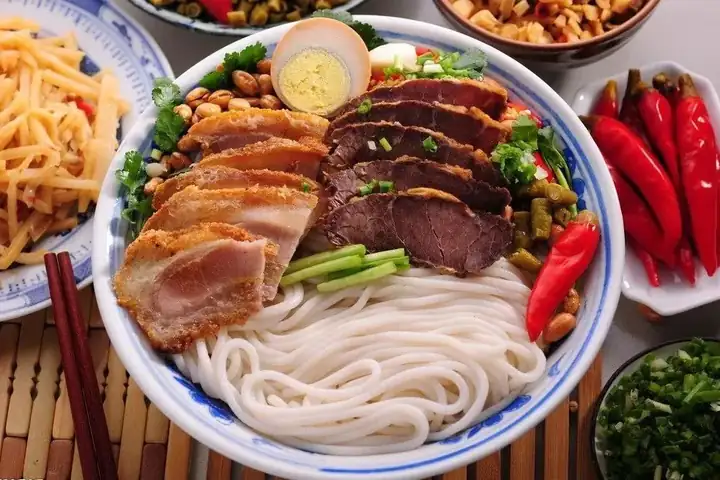
Image notes
Resized for the web; the photo itself has not been edited.
Baxian Rice Noodles (八仙粉) is a rice-noodle bowl recorded for Nanning in Guangxi: 米粉 served in broth with a set of toppings, a format that Guangxi eats at breakfast and at all hours.
How it is made
The noodles are 米粉, made with rice as the main material — a food the encyclopedia records as popular across southern China and Southeast Asia, where rice is grown. Rice noodles are described as pliable and springy: they do not turn to paste in the pot and they hold together when stir-fried. In a bowl of 粉 the noodles are blanched in hot water or stock for a moment, drained into a bowl and then covered with broth and toppings rather than cooked for a long time.
Flavour and texture
Expect soft but resilient noodles with a faint rice flavour of their own, and a bowl whose character comes from the broth and the toppings laid over them. Guangxi kitchens use both clear meat broths and stronger braised or pickled bases, and toppings usually mix something savoury with something sour or crisp — braised meat, offal, pickled bamboo or mustard greens, peanuts, spring onion and chilli. The name 八仙 suggests a set of several toppings rather than a single one, so the bowl tastes layered rather than uniform.
Local roots
八仙粉 is a Nanning entry, the capital of Guangxi, where rice-noodle bowls are the standard breakfast. Nanning's own best-known bowl is 老友粉, and the city has a deep bench of 粉 shops, so this entry sits inside a local culture of noodles rather than standing alone. The record supplies the name and the city, not a fixed list of toppings, so treat the number in the name as a description of abundance rather than an exact count you can hold a kitchen to.
Ingredients and dietary questions
Noodles and broth are the base: rice noodles, water, meat or bone stock and seasoning. Toppings can include pork, beef, offal, fish balls or dried seafood, plus peanuts and pickled vegetables, and chilli oil is often added at the table. Useful questions are 有猪肉吗 (is there pork), 有牛吗 (is there beef), 辣不辣 (is it spicy) and 可以不加辣吗 (can you leave out the chilli). If you avoid peanuts, say so before the bowl is assembled, since they are usually scattered on last.
How to order
Say 一碗八仙粉 (one bowl) and choose your noodle width if asked: 圆粉 (round) or 扁粉 (flat). Then answer the two standard questions — 要不要辣 (chilli or not) and 加不加蛋 or 加肉 (extra egg or meat). Useful extras are 葱花 (spring onion), 酸笋 (pickled bamboo) and 花生 (peanuts), and you can ask 少油 (less oil) if the broth looks rich. Paying first at a counter and then carrying a ticket to the noodle station is common practice.
How to eat it and plan a meal
Eat it straight away, using chopsticks for the noodles and a spoon for the broth; the noodles keep soaking and soften if the bowl sits. One bowl is a full breakfast or a light lunch for most people, and a side of 油条 or a cup of soy milk is the usual companion. In Nanning, a noodle stall is a quick stop rather than a leisurely meal, so expect to eat and go.
More dishes to compare
Explore related local specialties and compare their names, preparation notes and ordering guidance.
Laoyoufen 老友粉 →
Laoyoufen (老友粉) is Nanning's own signature bowl. Compared with 八仙粉, both are rice-noodle bowls ordered and eaten the same fast way, and the difference lies in the broth and the topping set: 老友粉 is known for a sour-spicy fermented base, while a 八仙 bowl is defined by the number of toppings arranged over the noodles.
Questions before you order
What are the eight ingredients in 八仙粉?
The name points to a generous set of toppings rather than a fixed list of eight. Toppings vary by shop and commonly include meat or offal, pickled vegetables, peanuts and spring onion over rice noodles in broth.
Is it always spicy?
No. Chilli is usually added at the counter or at the table, so you can ask for 不辣 (not spicy) or 少辣 (a little) when you order.
Source introduction: Wikipedia contributors: 米粉(维基百科条目原文,API 抓取) · CC BY-SA 4.0. English guide adapted from the cited material, with additional preparation and ordering guidance.
Sources & reading
The supplied food list supports this name and regional association. The culinary terms below are explained as menu vocabulary; a local recipe, origin story and venue availability have not been independently verified.