

Guiping Mung Bean Cake 桂平绿豆糕
Guiping Mung Bean Cake is featured among the local specialties of Guangxi.
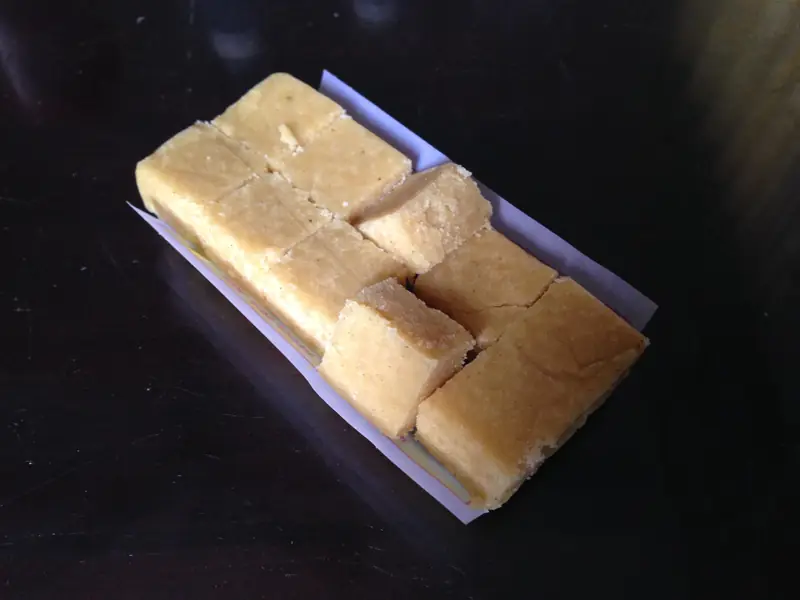

Photo adjustments
EXIF orientation normalized; resized without changing aspect ratio; converted to WebP. No subject edits.
Guiping Mung Bean Cake (桂平绿豆糕) is a mung-bean cake recorded for Guiping in Guigang, Guangxi: cooked beans mashed with sugar, pressed into moulds and eaten in small pieces.
How it is made
绿豆 — mung beans — are soaked, boiled until they collapse, then mashed and pushed through a sieve so the skins are left behind. The resulting paste is cooked down with sugar and oil until it holds together when pressed, and sometimes a little wheat flour or glutinous rice flour is worked in to firm the mixture. It is then pressed into a wooden or plastic mould, turned out as a small block or a patterned cake, and left to set. A well-made cake is dense enough to cut cleanly and dry enough not to stick to the fingers.
Flavour and texture
The texture is the giveaway: fine, dry and slightly sandy on the tongue, sweet but not syrupy, with the faint green-bean taste still visible under the sugar. Because the paste is cooked down rather than baked, the cake tastes cool and clean rather than caramelised, and it is often served in thin slices or small blocks with tea, which cuts the sweetness. Some makers add a little coconut, tangerine peel or sesame oil for aroma; a very sweet, very smooth version usually means more sugar and less bean.
Local roots
The cake belongs to Guiping in Guigang, eastern Guangxi, where mung-bean cakes and other pressed sweets are sold at market sweet counters and taken as gifts. It is festival and snack food rather than a dessert course in a restaurant, and it keeps well enough to travel. What is on record is the name and the city; whether a particular maker adds coconut, tangerine peel or a wheat-flour binder is local practice and is not documented here.
Ingredients and dietary questions
The core is mung bean and sugar with oil; additional ingredients may include wheat flour (so ask if you avoid gluten), glutinous rice flour, coconut, sesame or tangerine peel. Mung-bean cakes are usually vegetarian, but they are not low in sugar. Ask 有面粉吗 (does it contain wheat flour), 甜不甜 (how sweet is it), 有椰蓉吗 (is there coconut) and 能放多久 (how long does it keep) when buying.
How to order and buy it
At a sweet counter, ask for 一块 (one piece) or 一盒 (one box) and check whether the cakes are freshly made: 是今天做的吗. Useful questions are 甜的还是少糖的 (sweet or reduced sugar), 有几种口味 (how many flavours), 可以试吃吗 (may I taste one) and 怎么保存 (how should it be stored). Boxed versions are usually arranged for gifts, so ask for a plain pack if you just want to eat it.
How to eat it and plan a visit
Serve it in thin slices with plain tea, which balances the sweetness, and keep it out of the heat so the paste does not sweat. One or two pieces is a normal serving; the cake is dense, so a small box lasts a while. It also works as a light breakfast with soy milk, and unopened gift boxes keep for weeks, making it a sensible purchase to carry home from Guiping.
More dishes to compare
Explore related local specialties and compare their names, preparation notes and ordering guidance.
Lushui Savoury Rice Dumplings 露水汤圆 →
Lushui Savoury Rice Dumplings (露水汤圆) is the directory's entry for a Guangxi sweet served in liquid. Compared with 桂平绿豆糕, the contrast is dry against wet: one is a firm, sliceable bean paste that travels and is eaten with tea, the other a soft dumpling that has to be eaten straight away with its syrup or soup.
Questions before you order
Why does the cake taste sandy?
The beans are cooked and sieved into a paste but not blended smooth, so a fine, grainy texture remains. That is the traditional texture of a mung-bean cake rather than a fault.
Does it contain wheat?
Sometimes, because a little flour can be used to firm the paste. Ask 有面粉吗 if you are avoiding gluten, since the beans themselves are naturally gluten free.

Sources & reading
The supplied food list supports this name and regional association. The culinary terms below are explained as menu vocabulary; a local recipe, origin story and venue availability have not been independently verified.