

Hengzhou Giant Rice Dumpling 横州大粽
Hengzhou Giant Rice Dumpling is featured among the local specialties of Guangxi.
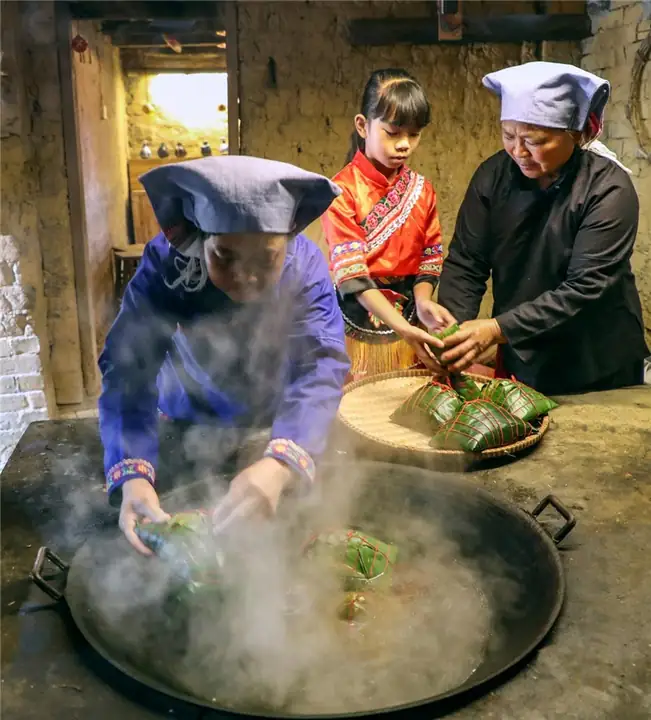
Image notes
Resized for the web; the photo itself has not been edited.
Hengzhou Giant Rice Dumpling (横州大粽) is an oversized zongzi from Hengzhou (横州), a city under Nanning (南宁), Guangxi: glutinous rice, mung beans and large pieces of fatty pork wrapped in leaves into a bundle that weighs three to four jin (about 1.5 to 2 kilograms). Writing in the Guangxi magazine Dangdai Guangxi (当代广西) in 2025, Li Ying (李莹) compares its size to a Hami melon.
Ingredients
The core is glutinous rice, mung beans and pork. The rice is judged by a local rule called "三粒寸" (three grains to a cun): three grains laid end to end should measure exactly one cun, a traditional Chinese inch. The pork is cut into pieces as big as two fists, and fatty cuts are preferred; Li Ying quotes her grandmother as saying an all-fat piece is never wrong. The meat is marinated with high-proof liquor. Depending on taste, cooks add dried cuttlefish, dried shrimp, chestnut kernels or cured meats.
How it is made
Because the pieces are so large, the pork goes into its marinade one to two days ahead. The leaves are boiled soft in hot water before they are scrubbed, since washing them raw makes them split. The rice is rinsed and the mung beans soaked; before hulled beans were sold, families split them on a stone mill and soaked off the skins.
To wrap one, four leaves are laid out on each side, then a layer of rice, a layer of mung beans and a layer of pork, followed by mung beans and rice again in mirror order. The bundle is patted into shape by hand, without a bowl or mould, and tied from end to end with string. In Li Ying's family a dozen or more were boiled together in a pot over half a metre deep, over a firewood fire lit before noon and tended in turns until after dark.
How it is eaten
In Hengzhou town (横州镇) the dumpling appears at traditional festivals and at important meals such as house-moving parties, weddings, birthday banquets and dinners celebrating a student's school or university place. It takes the centre of the table on a tray as wide as a basin. Once everyone is seated, the host snips the string at one end with scissors, the leaves fall open, and a few strokes of bamboo chopsticks split the dumpling so the smell of beans, pork, rice and leaves comes out at once. A wedding dinner for more than a hundred guests called for at least seventeen or eighteen of them.
Li Ying hears from relatives that fewer families now make their own: firewood is hard to buy, there is little open space for a big stove and pot, and the dumplings are easy to buy ready-made. Her parents still pack two into her husband's suitcase whenever he goes home to Shandong (山东).
More dishes to compare
Explore related local specialties and compare their names, preparation notes and ordering guidance.
Lingshan Giant Rice Dumpling 灵山大粽 →
Another large Guangxi zongzi; the Hengzhou version layers rice, mung beans and fist-sized fatty pork into a three-to-four-jin bundle.
Questions before you order
What is the three-grains-to-a-cun rule for Hengzhou Giant Rice Dumpling?
It is a local test of good glutinous rice: three grains laid end to end should measure exactly one cun, a traditional Chinese inch.
Sources & reading
Written from the linked sources and fact-checked against them on 2026-09-24. Recipes and servings vary between kitchens.