

Huangyao Steamed Pork Ribs with Black Beans 黄姚豆豉蒸排骨
Huangyao Steamed Pork Ribs with Black Beans is featured among the local specialties of Guangxi.

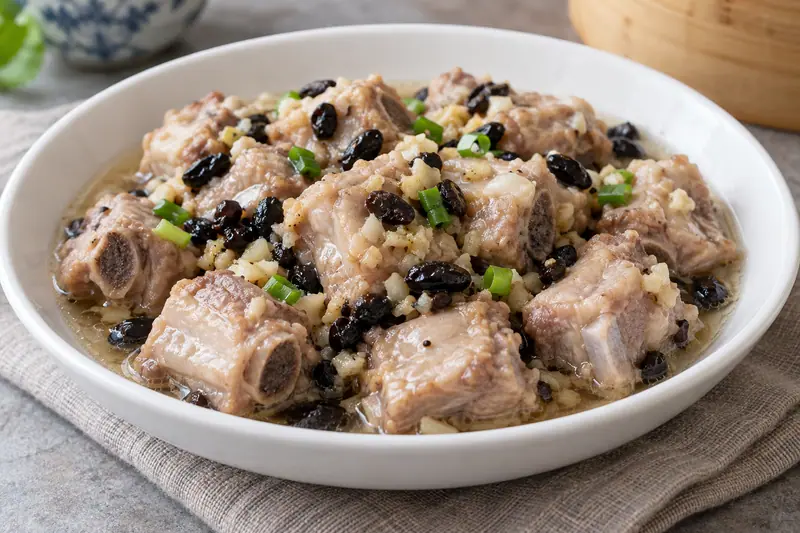
Huangyao dou chi zheng pai gu is pork ribs steamed with Huangyao black beans — a mild, lightly salted douchi the old town has been making for centuries.
How it is made
The beans come first. Huangyao douchi is made from a black-soybean variety local to the town together with water from its old wells, put through three rounds of steaming and drying and two fermentations using edible mould. The described sequence runs through soaking, steaming, fermenting, blending and sealing the jar.
To keep it, makers steep the finished beans in high-proof rice wine. The alcohol lifts off over time and in doing so deepens the bean flavour, and it is also what gives the beans the property cooks prize here: they hold their shape through long cooking instead of breaking down.
Flavour and texture
This is a light douchi. The provincial trade description calls it 淡豆豉 and notes that it is not very salty, with a flavour and mouthfeel quite unlike the douchi sold in Guangzhou — the aroma is described as rich enough to carry into the next room.
Steamed with pork ribs, the beans do the seasoning work slowly, so the ribs come out savoury and lightly fermented rather than sharp or heavily salted.
Local roots
Huangyao douchi is one of the three treasures of Zhaoping and, by the local account, goes back to the early Ming, when Han migrants brought the technique with them from Guangdong. It was already well known before the Kangxi reign and most famous under the Qianlong emperor, when it is said to have been sent to the court.
The 1759 edition of the Zhaoping county gazetteer records douchi as a Huangyao speciality that other places could not match. In 2008 the making technique was listed as regional intangible heritage, and in 2012 the product was designated a national geographical-indication protected product.
Ingredients and dietary needs
Black soybeans, local spring water and rice wine, with pork ribs for this dish. Soybeans and soy sauce are the base of the flavour, so the dish is not suitable for anyone avoiding soy.
Because douchi is fermented, the aroma is strong and the flavour is not simply salty. If the kitchen adds chilli or extra soy, ask before ordering.
How to order
Ask for 黄姚豆豉蒸排骨. A plate is 一盘, and it is normally ordered as one dish among several to share with rice.
不要辣 asks for it without chilli, 少放豉油 asks for less soy, and 用黄姚豆豉吗 asks whether the beans are the Huangyao ones rather than a generic douchi.
How it is eaten
It comes to the table still in its steaming dish, and the beans and the juices left in the bottom are the best part — spoon them over rice rather than leaving them behind.
The ribs are bone-in and cut small, so it is a hands-and-chopsticks dish. One plate is a shared portion; if you are in Huangyao, ask whether the kitchen also does a 豆豉宴, the multi-dish menu built around the beans.
More dishes to compare
Explore related local specialties and compare their names, preparation notes and ordering guidance.
Roast Duck Rice Noodles 烧鸭粉 →
烧鸭粉 is a rice-noodle bowl carried by roast duck: the flavour is cooked into the meat first and then passed to the broth. 黄姚豆豉蒸排骨 works the other way — the seasoning is fermented in advance, over months of steaming, drying and curing, and only then is it steamed gently with the ribs so that the beans and the meat arrive at the table together.
Questions before you order
Is Huangyao douchi very salty?
No. The provincial trade description classifies it as 淡豆豉, a light douchi that is not very salty and tastes different from the douchi used in Guangzhou cooking.
Why do the beans survive long cooking?
They are steeped in high-proof rice wine for keeping, which the local account says deepens the bean flavour and gives them their long-cooking, shape-holding quality.
Sources & reading
The supplied food list supports this name and regional association. The culinary terms below are explained as menu vocabulary; a local recipe, origin story and venue availability have not been independently verified.