

Crispy Cured Beef Strips 牛腊巴
Crispy Cured Beef Strips is featured among the local specialties of Guangxi.

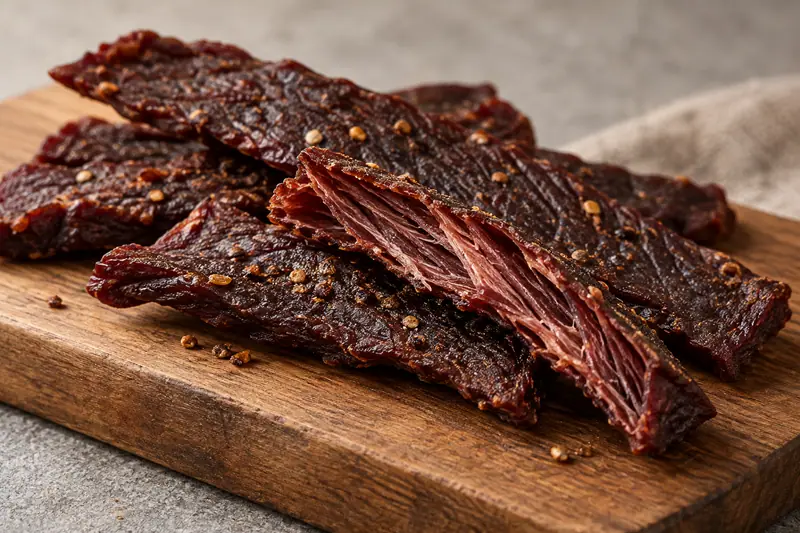
Crispy Cured Beef Strips (牛腊巴) are slices of spiced beef roasted over charcoal and then finished in oil, a snack of Liucheng County (柳城县) in Liuzhou (柳州), Guangxi. The Liucheng county government counts them among the county's ten 'gold medal' snacks, and the Liucheng beef laba making technique entered Guangxi's seventh autonomous-region intangible cultural heritage list in 2018.
How it is made
A Liucheng county government profile of Lan Shuping (兰舒平), a maker in Zhailong town (寨隆镇), describes a two-day job of more than ten steps. On the first day the beef is cut, marinated and roasted; it is then left overnight to cure, and on the second day it is cut again, stir-fried, seasoned, cooled and packed. She uses only hind-leg meat from local yellow cattle, cut along the grain so that it roasts into shreds, and one jin of fresh beef gives about three liang of finished laba.
The meat is marinated for at least an hour and a half in more than 20 spices, among them ginger and star anise, together with strong baijiu (白酒). The slices go on oiled wire trays in an oven heated by charcoal pans at the bottom and are turned two or three times. After cooling they are passed through oil, with sesame and chilli added as the oil temperature is controlled. In Taiping town (太平镇), the Liucheng county government reports, the roasted strips are fried in camellia oil (山茶油).
Flavour and texture
The finished laba is a soy-red colour. The first taste is of the spices, then the sweetness of the beef; the meat is loose and shreddy in the mouth and leaves a taste of charcoal smoke. In Taiping the camellia-oil frying gives it a firm chew, and besides the plain and hot-spicy versions, cumin and honey flavours are now made there.
Where it comes from
A local legend, retold by the Liucheng county government, says that the Tang writer Liu Zongyuan (柳宗元), demoted to Liuzhou as prefect in the Yuanhe era (元和), stopped at an inn in what is now Taiping, where he drank the locals' home-brewed wine and ate their beef laba. On waking he found both gone and sighed 'Jiu xing bu jian niu laba' (酒醒不见牛腊巴, 'I sobered up and the beef laba was gone'). Local people serve it to guests, and one Taiping maker first sold it as a side dish in his rice-noodle shop.
Sources & reading
Written from the linked sources and checked sentence by sentence against quoted extracts by a separate reviewer on 2026-09-26. Recipes and servings vary between kitchens.