

Fermented Sand-Crab Sauce 沙蟹汁
Fermented Sand-Crab Sauce is featured among the local specialties of Guangxi.
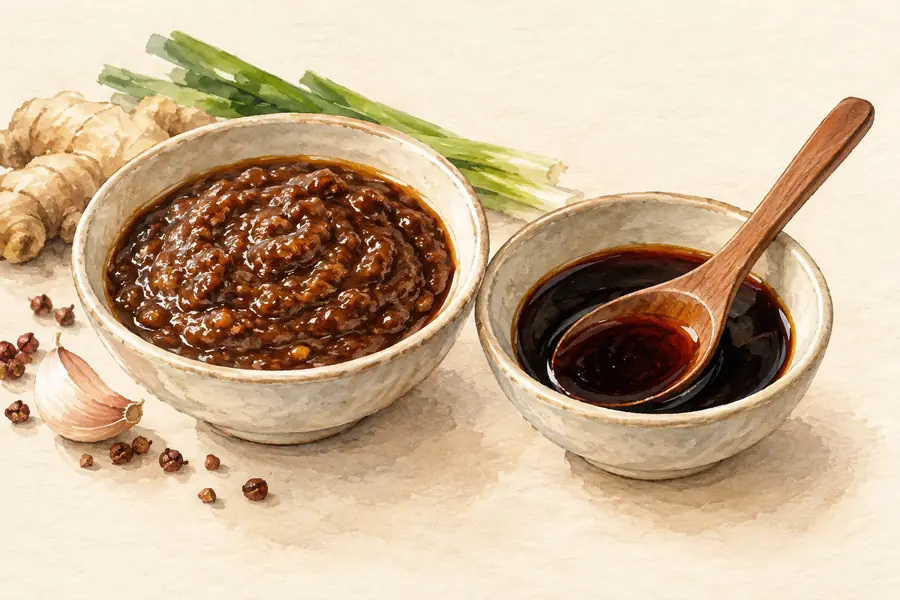
Fermented Sand-Crab Sauce (沙蟹汁) is a dipping sauce of pounded, salted and fermented sand crabs made in the coastal villages and towns of Beihai (北海), Guangxi. Guangxi News calls it a condiment unique to Beihai. The Beihai sand-crab sauce making technique entered Guangxi's seventh autonomous-region intangible cultural heritage list in 2018.
How it is made
The crabs are sand crabs that come out of their burrows on the shallow flats at low tide to feed. Local fishers reckon the tides in their own units, and Zhou Juncui (周君翠), a bearer of the making technique, plans her work around each tide and starts as soon as she is back, because the crabs die quickly and lose their freshness.
The crabs are washed by hand in clean seawater, with the water changed several times. The belly flap is removed and the innards squeezed out. The crabs then go into a clean, dry earthenware jar and are pounded with a wooden pestle, with ginger slices, garlic, baijiu (白酒), chopped chilli and a large amount of salt added along the way, until the mass is a paste. It is sealed in jars and left in a cool, airy place to ferment.
After about seven or eight days the sauce can be eaten; kept for about a month it becomes richer. Guangxi News calls fermentation the key point for quality, and Zhou says that if it goes wrong, all the earlier work is wasted: the sauce takes on a strong fishy smell or even spoils.
Flavour and texture
Good sauce smells strongly of crab, and its liquid is clear and amber-coloured. The taste is salty and savoury.
How it is eaten
People in Beihai put it on the table at every meal. Asked for its best partners, locals name white-cut chicken (白切鸡) and long beans, and the sauce is also used to braise beans in a Beihai dish, sand-crab sauce braised beans (沙蟹汁焖豆角). It is used as a dip for fruit too, such as watermelon and star fruit. Beihai sand-crab sauce with white-cut chicken appeared in a May 2014 episode of the documentary A Bite of China (舌尖上的中国).
Sources & reading
Written from the linked sources and fact-checked against them on 2026-09-26. Recipes and servings vary between kitchens.