

Kung Pao Chicken 宫保鸡丁
Kung Pao Chicken is featured among the local specialties of Guizhou.
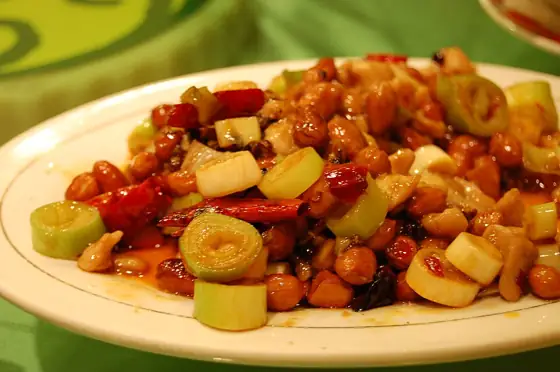
Kung Pao Chicken (宫保鸡丁) is diced chicken stir-fried with peanuts and chilli. Its namesake, the late-Qing official Ding Baozhen (丁宝桢), was born in Zhijin (织金) in Bijie (毕节), which the Guizhou Provincial Department of Culture and Tourism calls the dish's place of origin. Chinese Wikipedia describes it as a dish that began in Guizhou cooking, travelled to Shandong and took final form in Sichuan cuisine; in Guizhou it is also called hula zi jiding (糊辣子鸡丁, "scorched-chilli diced chicken").
Where it comes from
Ding Baozhen came from Niuchang (牛场) in what was then Pingyuan (平远州), today Zhijin County, and served as governor of Shandong and then governor-general of Sichuan. An article on Chinese Social Science Net (中国社会科学网) says he liked diced chicken breast with a few peanuts, stir-fried with the ciba chilli (糍粑辣椒) that Guizhou people favour, and kept it on his household table wherever he held office. After his death he was given the honorary title of Grand Guardian of the Heir Apparent, which earned him the name Ding Gongbao (丁宫保), and the dish took the same name.
The Kung Pao Chicken cooking technique of Zhijin County is on Guizhou's fifth list of provincial intangible cultural heritage, published in 2019. A Bijie local-culture book reprinted by Guizhou Culture Net (贵州文化网) adds that the dish is named among the ten classic dishes of Guizhou in the "Chinese Cuisine" (中国菜) selection.
How it is made
What sets the Guizhou version apart is ciba chilli where Sichuan cooks use dried chilli pieces. According to the same department, Zhijin cooks use local chicken and oily ciba chilli, and borrow the thickened sauce and sauce-frying (酱爆) methods of Shandong cooking.
The Bijie book describes the steps: chicken breast is diced, sometimes scored with shallow cuts so it cooks evenly and holds the sauce, then seasoned with light soy sauce, salt and cooking wine and coated in starch. Ciba chilli or dried chilli is fried over a low flame until fragrant, spring onion goes in next, then the chicken until it changes colour, and a prepared sauce thickened with starch finishes the dish. The oil should be moderately hot, so that the chicken hisses softly when it goes in.
Flavour and texture
Chinese Wikipedia describes the Guizhou version as salty and hot with a slight sweet-sour edge. The provincial culture and tourism department says the Zhijin dish is sour and hot, with the thickened sauce softening the chilli. The Bijie book asks for a red, glossy plate with separate, tender pieces of chicken and crisp peanuts, hot but not fierce, eaten with a bowl of rice.
Sources & reading
Written from the linked sources and fact-checked against them on 2026-09-26. Recipes and servings vary between kitchens.
Image credits & notes (1)
- Serving example. Kung Pao chicken dish served at a Sichuan restaurant in Shanghai. (Although I am not Chinese myself, I have some reason to believe that this is a reasonably authentic version of the dish: the restaurant was…Photo: Steven G. Johnson · CC BY-SA 3.0Resized for the web; the photo itself has not been edited.
