

Tabletop griddle barbecue 烙锅
Guiyang’s 烙锅 (laoguo) is a shared Guizhou tabletop griddle: diners finish partly cooked meat, vegetables, tofu and rice cakes on a hot clay or iron pan, then dip each bite in chilli-based sauces. It is a Guizhou-wide tradition with a famous Shuicheng lineage, not a fixed recipe or single restaurant.
Tap any red Chinese text to hear it in Mandarin.
What it is
烙锅 (laoguo) is a communal griddle meal rather than one fixed plate. In Guiyang it is closely associated with late-night eating: a pan is heated at the table, ingredients are cooked in batches, and everyone adjusts the final browning and crispness to taste. This participatory style—rather than a single “correct” ingredient list—is central to the experience.
The dish belongs to Guizhou’s wider food culture. The best-known regional lineage is 水城烙锅 (Shuicheng laoguo), associated with today’s Liupanshui area and described by Guizhou’s culture-and-tourism authorities as a tradition with more than 300 years of history. That history and reputation should not be turned into a claim that every Guiyang version follows one Shuicheng recipe: Guiyang has its own late-night versions, and menus differ between kitchens.
How the griddle works
A traditional black-sand or clay griddle is often raised in the middle and lower around the edge. Oil can run towards the rim and be spooned back over the food. Flat iron pans are also used, so the vessel is a useful clue rather than a test of authenticity. In the Guiyang style described by People’s Daily, the kitchen partly cooks the ingredients first; diners then take over, deciding how far to sear them and how much crispness they want.
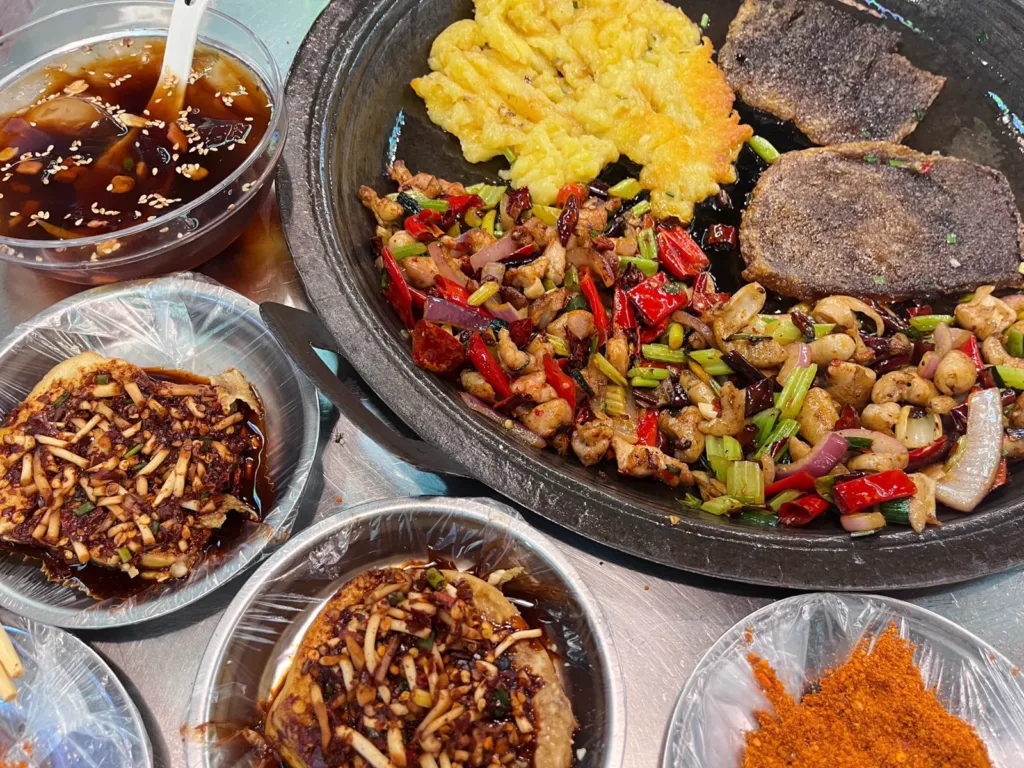
Common things to look for include 洋芋粑 (potato cakes), fresh beef, 五花肉 (pork belly), beef tendon, chicken skin, vegetables, 臭豆腐 (fermented tofu), sweet-potato noodles, 黄粑 (sweet rice cake) and 二块粑 (a chewy rice cake). A particular menu may offer only some of these, or add seafood, offal or other local ingredients. The useful question is what is available that day, not whether a restaurant has every item on a standard list.
The sauces make the same pan taste different from bite to bite. Examples documented for Guizhou laoguo include 五香辣椒面 (five-spice chilli powder), 麻辣折耳根蘸水 (a hot, numbing dip with fish mint) and 烧青椒蘸水 (roasted-green-chilli dip). Chilli, garlic, peanuts, sesame and fresh herbs may appear in different combinations, so ask what is in the dip before mixing your own.
How to find and eat it in Guiyang
Keep the Chinese name 烙锅 Lào Guō handy. On Meituan (美团) or Amap/Gaode Maps (高德地图), search 贵阳烙锅 Guì Yáng Lào Guō or 烙锅 Lào Guō near your current itinerary. Use the map only as a way to find nearby choices, not as an endorsement of ranking. Before going, open the current menu and recent reviews, then check today’s opening status and whether the particular ingredients you want are actually being served. Do not assume that a listing, an old review or a photograph proves current supply.
If you do not eat meat or offal, say so before ordering and ask which vegetables, tofu or rice cakes are cooked separately. A vegetable item is not automatically vegetarian when the pan, oil or dipping sauce is shared. Anyone with a peanut, sesame, soy, seafood or other food allergy should ask about the sauce and shared cooking surface; recipes and cross-contact controls vary. Meat and organ items should be cooked through, and the safest way to get the texture you want is to ask the staff which items arrive partly cooked and which need longer on the griddle.
Because 烙锅 is a dish rather than a single attraction, it has no universal address, ticket, reservation rule or transport route. Choose a current option near your planned walk, verify the details on the day, and treat each menu as a local variation rather than a promise of one “most authentic” version.
Image credits & notes (1)
- A regional Guizhou laoguo meal on a black griddle, with cooked ingredients, yellow cakes and several dipping sauces; the exact venue and location are not stated on the source page. Photo: WYRRRRPhoto: CC BY-SA 4.0