

Panzhou Cured Ham 盘州火腿
Panzhou Cured Ham is featured among the local specialties of Guizhou.
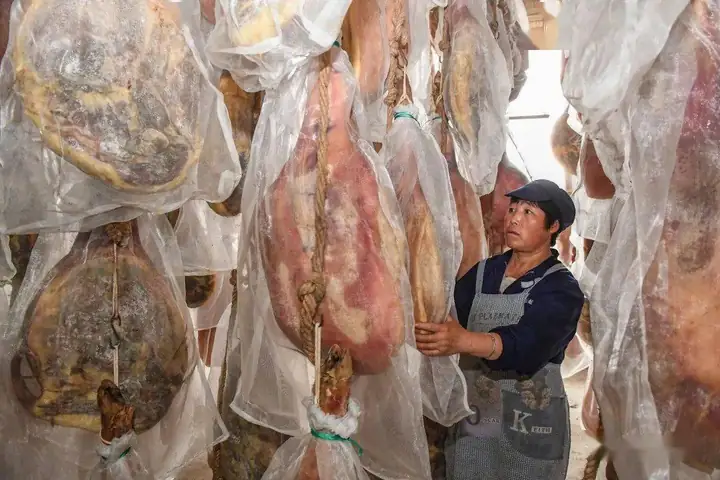
Photo adjustments
EXIF orientation normalized; resized without changing aspect ratio; converted to WebP. No subject edits.
Panzhou Cured Ham (盘州火腿) is the salted or smoked pork leg of Panzhou (盘州) in Liupanshui (六盘水), Guizhou. Guizhou Daily (贵州日报) notes the older names "huorou" (火肉, fire meat) and "lanxun" (兰熏), and the Panzhou civil affairs bureau groups it with Jinhua (金华) and Xuanwei (宣威) ham as one of China's three famous hams. It became a national geographical-indication product in 2012.
Where it comes from
According to the Panzhou civil affairs bureau, the ham goes back to the early Ming dynasty, when migrants from Jiangnan (江南) moved into what was then Pu'an Prefecture (普安州) and ham was an important food for the garrison, farming and merchant settlements, stored in winter and eaten in summer. By the middle and late Ming it was a local gift and a standard item at weddings, and by the early Qing, the bureau writes, citing old gazetteers, it was a trade good sent to Guiyang (贵阳) and Yunnan (云南). Guizhou Daily reports that households across Panzhou still cure and eat ham, and that Panzhou ham-making is a provincial-level intangible cultural heritage item.
How it is made
The hams come mainly from the Wujin pig (乌金猪), a local breed that the bureau describes as free-ranging and fed on cooked pig forage, which gives it firm bodies and well-developed hind legs. Curing follows six steps: the raw leg is trimmed into shape; salt is rubbed and massaged into the meat; the leg is washed and sun-dried to draw off salt; it is trimmed into a pipa (lute) shape; it is hung to air and ferment; and finally the hams are graded by a three-needle aroma test. The bureau puts the pig's rearing at more than 280 days and the natural fermentation at more than 730 days, and gives a fat-to-lean ratio of 2:8 with low salt. Wang Fusheng (王福生), the representative bearer of the provincial heritage item, told Guizhou Daily that salting alone demands close control of speed, thickness and evenness.
How it is eaten
In Panzhou the ham is steamed, stewed, stir-fried or eaten raw. Slices are steamed on a plate for about ten minutes; stir-fries pair it with ginkgo nuts, green peppers or fish mint (鱼腥草); the trotter end is stewed with kidney beans and ginkgo. Ham fermented for more than two years is sliced thin and eaten raw, and the bureau suggests red wine with it. Guizhou Daily describes the meat as tender, strongly aromatic and savoury.
Sources & reading
Written from the linked sources and checked sentence by sentence against quoted extracts by a separate reviewer on 2026-09-26. Recipes and servings vary between kitchens.