

Cold Buckwheat Jelly 荞凉粉
Anshun’s 荞凉粉 (qiáo liángfěn) is a chilled Guizhou buckwheat snack: a set sweet-buckwheat jelly is cut or scraped into pieces or fine strips, then eaten with a separate spicy, sour and aromatic dip. The better-documented 织金荞凉粉 is a specific Zhijin version of the wider dish family, not a claim that every Anshun serving follows one fixed recipe.
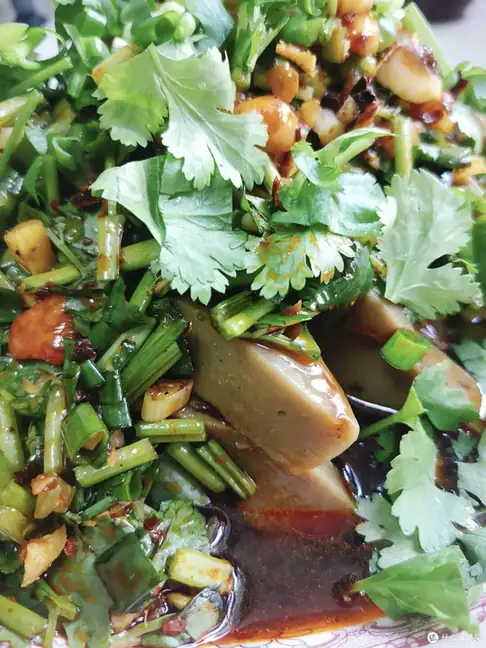
Image notes
Resized for the web; the photo itself has not been edited.
Tap any red Chinese text to hear it in Mandarin.
What it is
In Anshun, 荞凉粉 Qiáo Liángfěn is a local snack rather than a dish tied to one particular restaurant. The Anshun municipal government includes it in its official “Eat in Anshun” food guide. Its individual entry describes a jelly made from Guizhou highland sweet buckwheat, served either in slices or scraped into strips, with fermented bean curd, red chilli oil, ginger water, garlic, spring onion, roasted soybeans and peanuts.
The texture is the point: cool, soft and smooth, with a clean buckwheat aroma, while the dip supplies the salt, sourness, chilli heat and savoury depth. A provincial tourism guide for Anshun similarly describes the jelly as cut or scraped and paired with soy sauce, vinegar, aromatics, sesame oil, roasted soybeans, peanuts, chilli oil and Anshun-style fermented bean curd.
From buckwheat to jelly
The most detailed public method is for 织金荞凉粉 Zhījīn Qiáo Liángfěn, the Zhijin version from Bijie. The official Zhijin Cave Scenic Area management page says that hulled buckwheat is dry-ground into flour, mixed with water and a measured amount of alum water at a flour-to-water ratio of 1:4, then cooked over low heat while stirred. The thick mixture is cooled in a basin until set. It is then turned out and scraped with a special tool into long, fine strips.
That method should be read as a documented Zhijin technique, not as a universal formula for every bowl in Anshun. The Anshun municipal entry uses a shorter description of grinding sweet buckwheat into a slurry and simmering it until solid, while the provincial guide focuses on the finished shape and dressing. The distinction matters because “荞凉粉” is the dish name you can use in Anshun, whereas “织金荞凉粉” points to a place-named version. The provincial intangible-cultural-heritage list records “小吃制作技艺(荞凉粉制作技艺)” under Zhijin County, Bijie.
How to eat it
A typical serving is not a hot soup. The jelly is cooked, cooled until firm and served cold. In the documented Zhijin style, the scraped strips sit on a plate and the seasoned mixture is made in a separate small bowl for dipping. The Anshun description also records the older habit of eating cut pieces with a small bamboo fork.
Start with a little dip so you can taste the buckwheat before adding more chilli oil, vinegar, fermented bean curd or garlic water. Roasted soybeans and peanuts add the main crunch against the tender jelly. Local descriptions call it refreshing and cooling, especially as a warm-weather snack; a 2026 Anshun government feature also places 荞凉粉 among old-city summer street foods and describes dips built around fermented bean curd, chilli and vinegar. This is a seasonal cue, not a promise that every stall is open or serving it on every date.
Finding a serving in Anshun
Use the Chinese name 荞凉粉 Qiáo Liángfěn when asking or searching. If you specifically want to compare the Zhijin-labelled version, also try 织金荞凉粉 Zhījīn Qiáo Liángfěn. In Anshun, search the exact Chinese name on Meituan (美团) or Amap/Gaode Maps (高德地图) after you arrive. Check the current menu, recent reviews, opening status and whether 荞凉粉 is actually available that day. Platform rankings are only search results, not an endorsement, and a shop’s particular dip or shape should not be treated as the single standard for the dish.
There is no single ticketed attraction, reservation system, address or public-transport route for the dish itself. This entry therefore does not recommend a named business, publish a shop address or give a door-to-door route. Plan transport to your chosen food area separately, then confirm the current listing and supply before walking or taking a taxi.
Practical cautions
The dressing commonly includes soy-based ingredients, fermented bean curd, roasted soybeans, peanuts, chilli and strong aromatics. Ask what is in the dip if you have buckwheat, peanut or soybean allergies, avoid chilli, or need a vegetarian or vegan version; recipes and cross-contact practices vary by vendor. “Cold” describes the serving temperature after the jelly has been cooked and set, not a raw preparation. The Chinese name to show on a phone is 荞凉粉 Qiáo Liángfěn.
More dishes to compare
Explore related local specialties and compare their names, preparation notes and ordering guidance.
Zhi Jin Qiao Liang Fen 织金荞凉粉 →
Zhi Jin Qiao Liang Fen is the version filed under Zhijin County, where the buckwheat jelly described by the Bijie municipal portal is made. The plain name covers the family of cold buckwheat jellies around the province, while the Zhijin label points to the county whose official description sets out the ratio, the low-flame stirring, the scraping to strips and the full dipping mixture.