

Haikou vegetable casserole 海口斋菜煲
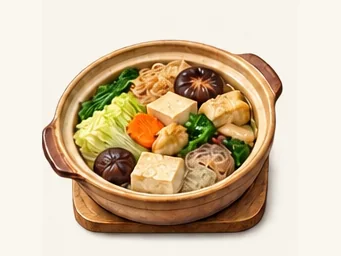
Haikou vegetable casserole (海口斋菜煲) is a Qiongbei New Year dish built from tofu products, glass noodles, mushrooms and vegetables simmered in one pot. Its appeal is not a fixed recipe but a local custom: on the first day of the lunar year, families traditionally eat a meat-free pot whose ingredients carry wishes for cleanliness, diligence and prosperity.
Tap any red Chinese text to hear it in Mandarin.
What this dish is
海口斋菜煲 is a shared casserole associated with Haikou and the Qiongbei area of northern Hainan. Its most important setting is the Lunar New Year rather than a particular restaurant: on the first day, the custom of not killing animals makes a vegetarian pot an appropriate family dish.
The usual idea is a collection of ingredients cooked together, not one tightly standardised recipe. Dried mushrooms, black fungus, daylily, bean-curd sheets or fried tofu, glass noodles, bean sprouts, water celery and other seasonal vegetables are common examples. The exact selection changes from household to household and from kitchen to kitchen.
That variation matters when reading a menu. A traditional meat-free pot and a restaurant’s modern “vegetarian hot pot” may share the name but not the broth. Some commercial versions are adapted for hot-pot dining and may be served with meat or use chicken, bone or other non-vegetarian stock.
How it is prepared and eaten
A traditional preparation gives each ingredient separate attention. Dried items are soaked, rinsed and briefly blanched. They may then be stir-fried or simmered separately so that they take on seasoning without losing their texture. Fresh vegetables are cut and stir-fried, while tofu is often fried until golden. The ingredients are finally combined with water and seasoning, then arranged in a clay pot and brought back to a simmer.
The result is a pot with changing textures rather than a smooth vegetable soup: glass noodles turn soft and slippery, tofu products stay tender or springy, and mushrooms and fungus provide a more resilient bite. The vegetables keep the bowl from feeling uniform. Serve it as a shared centre dish, taking a little of each ingredient rather than treating it as a single portion of soup.
The New Year meaning
For Haikou families, the dish belongs to the first day of the lunar year, when “eating zhai” means eating vegetarian food and starting the year in a clean, restrained way. A local account describes the custom as a break from the meat-heavy New Year feast, while also linking the ingredients to everyday hopes: celery is associated with diligence, long noodles with an unbroken flow of good fortune, and golden tofu with wealth. These are popular auspicious readings, not a compulsory ingredient list.
The tradition is now also part of Haikou’s wider food scene. Reporting from Haikou describes the casserole being served in established local restaurants and enjoyed by visitors as well as residents, but the dish still makes most sense when understood as a family and festival food that has entered everyday dining.
How to order it
Show the Chinese name 海口斋菜煲 Hǎikǒu Zhāicài Bāo when asking for the dish. If you need a strictly vegetarian or vegan meal, ask before ordering:
- 这是全素吗? Zhè shì quánsù ma? — Is this fully vegetarian?
- 汤底有没有鸡汤、骨汤、蚝油或海鲜? Tāngdǐ yǒu méiyǒu jītāng, gǔtāng, háoyóu huò hǎixiān? — Does the broth contain chicken stock, bone broth, oyster sauce or seafood?
- 有没有蒜或其他辛香料? Yǒu méiyǒu suàn huò qítā xīnxiāngliào? — Does it contain garlic or other strong aromatics?
- 会不会和荤食共锅? Huì bu huì hé hūnshí gòng guō? — Is it cooked in the same pot as meat?
Do not infer that “斋菜” guarantees a particular religious or allergy standard in a commercial kitchen. Traditional descriptions exclude animal ingredients, but restaurant adaptations can change the stock, sauces, side dishes and cooking arrangement.
Where to eat it
You can find Haikou vegetable casserole all over Hainan, so there is no need to seek out one particular restaurant. To find one near you, search for “海口斋菜煲” in Meituan (美团) or Amap (高德地图) and check recent reviews, distance and opening hours.
More dishes to compare
Explore related local specialties and compare their names, preparation notes and ordering guidance.
Wenchang chicken 文昌鸡 →
A Wenchang chicken is gently poached or prepared in a similar white-cut style, rested and chopped into bone-in pieces. A separate dipping sauce supplies additional salt, citrus or aromatic flavor. The meat is firm yet tender, with supple skin and a clear chicken taste. The method emphasizes the bird's texture more than a heavy sauce.
Hainan herbal rice-dough sweet soup 鸡屎藤粑仔 →
The prepared plant is combined with rice flour to make a coloured dough, which is formed into small pieces and cooked. These pieces are served with a sweet liquid; shape and soup thickness differ by maker. Expect a chewy rice texture and a herbal aroma, softened by the sweet broth. Ginger adds warmth when included, while coconut milk makes the soup richer and changes the flavour substantially.
Sources & reading
Recipes and servings vary between kitchens.