

Wuzhishan Wild Greens 五指山野菜
Wuzhishan Wild Greens is featured among the local specialties of Hainan.
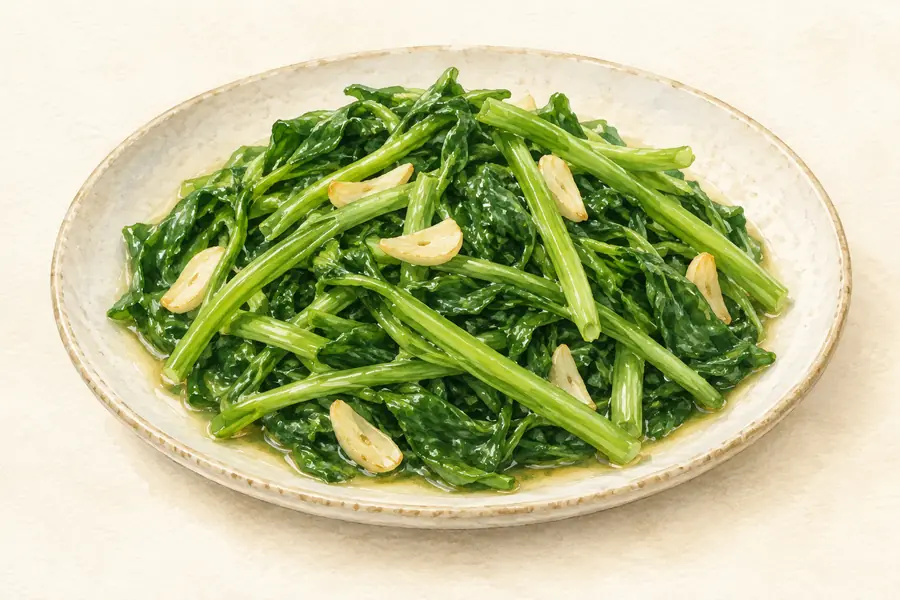
Wuzhishan Wild Greens (五指山野菜) are the wild vegetables of Wuzhishan (五指山), a tropical, rain-rich city in Hainan, eaten for generations by the Li (黎族) people and now also grown in greenhouses. China News Service sums up three of them: crisp, tender shuzai cai (树仔菜), fragrant and smooth lushe cai (鹿舌菜), and sour, juicy leigong sun (雷公笋).
Ingredients
A survey by Liang Liu (梁柳), associate professor at Hainan Tropical Ocean University (海南热带海洋学院), and colleagues counted 88 wild greens eaten traditionally by the Li of the Wuzhishan area: 58 herbaceous plants, 16 vines, 9 trees and 6 shrubs. What goes into the pot is mostly tender stems and leaves. Until recently only a few were planted, among them shuzai cai (katuk, 守宫木), longxu cai (龙须菜, the young shoots of chayote), baihua cai (白花菜, a small-flowered nightshade) and lushe cai.
Leigong sun, the 'thunder-god shoot', is not bamboo but a plant of the ginger family; its tender stems are the part eaten, and Hainan people named it for the way it shoots up after thunderstorms.
How it is eaten
In Hainan's central and western mountains, the Li and Miao (苗族) dress wild greens cold, stir-fry them or stew them, turning them into dishes such as leigong gen soup (雷公根汤) and plain stir-fried geming cai (清炒革命菜). At a Haikou (海口) food stall that brings its greens from the central mountains, Hainan Daily found leigong sun cooked two ways in 2023: stir-fried on its own, or boiled and sealed in salted rice water for about a week as a pickle that later goes into stir-fries with meat and into soups.
In April 2024 the greens had their own contest: at the 'Rainforest Flavour' (雨林味道) wild greens cooking contest on Sanyuesan Square (三月三广场) in Wuzhishan, 15 chef teams cooked with local ingredients such as shuzai cai and shiye cao (食叶草).
Where it comes from
Wuzhishan grows its wild greens alongside tea and tobacco as one of its 'three leaves' (三片叶). Shuzai cai is one of the greens furthest along in domestication: about 670 mu (roughly 45 hectares) are planted, mostly by smallholders in Tongshi (通什镇) and Nansheng (南圣镇) towns. It is grown from cuttings, and like Chinese chives it sends up new shoots that can be picked every four or five days. Researchers at the Chinese Academy of Tropical Agricultural Sciences (中国热带农业科学院) short-listed 18 greens for cultivation, and by early 2025 Xinhua reported more than ten varieties grown in greenhouses.
Sources & reading
Written from the linked sources and fact-checked against them on 2026-09-24. Recipes and servings vary between kitchens.