

Dressed Rice Noodles 腌粉
A Haikou-style bowl of very fine Hainan rice noodles dressed with a thick savoury gravy, crisp toppings and, often, a clear shellfish broth to finish.
Tap any red Chinese text to hear it in Mandarin.
What the name means
In Haikou, 腌粉 (yanfen) is the local name commonly used for the fine-noodle form of 海南粉 (Hainan fen). The noodles are dressed and mixed with sauce and toppings rather than served as a plain bowl of soup; here, the name describes that mixing style, not a requirement that the noodles be pickled.
The traditional noodle-making description is unusually hands-on. Rice is scalded, soaked, ground into a slurry, filtered and pressed through a cloth or perforated bag into boiling water. The fine strands are then cooled and drained. This is a description of the traditional craft, not a promise that every stall makes its noodles on site.
What arrives in the bowl
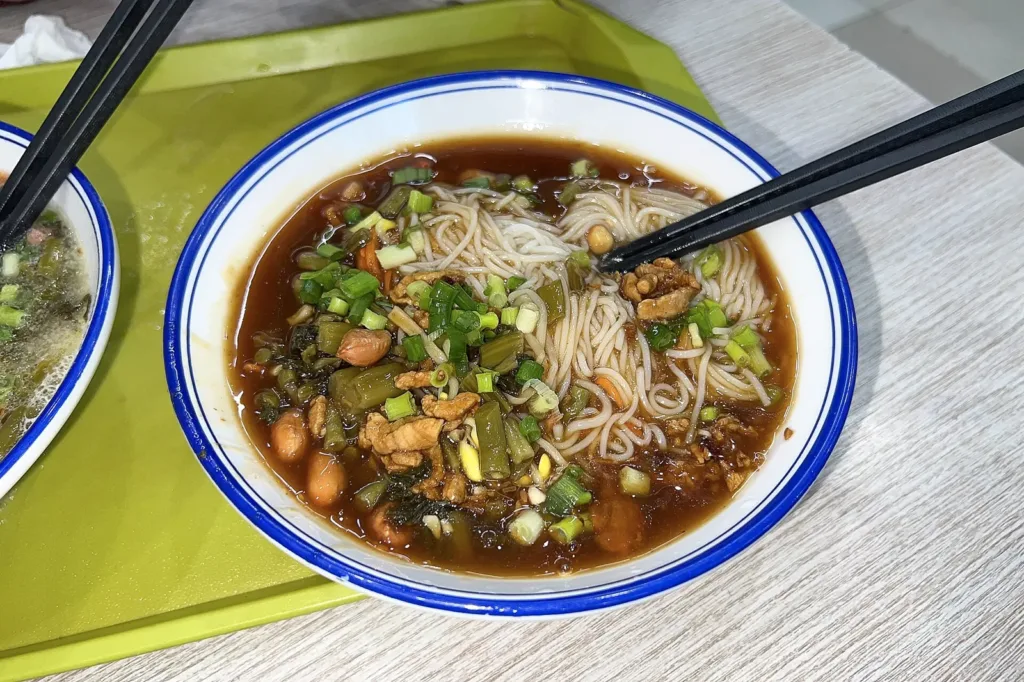
The fine white noodles are dressed with dark soy sauce, garlic, garlic-fragrant peanut or sesame oil and cooked bean sprouts. A hot, starch-thickened gravy follows; traditional descriptions include shredded meat, bamboo shoots and shrimp. Common finishing ingredients include dried beef, fried squid, fried peanuts, toasted sesame, crisp fried dough pieces and chopped coriander. The list and proportions vary between kitchens, so the bowl is better understood as a style than as a fixed recipe.
The strands are thin enough to hold onto the gravy. Mix from the bottom with chopsticks before eating, so the sauce reaches the noodles instead of remaining as a layer beneath loose toppings. Chili sauce is optional.
The broth and the last few bites
A bowl of clear broth may arrive alongside the noodles. It is described variously as sea-snail broth or clam broth, and the shellfish used can differ. Sip it with the dressed noodles, then—if the stall serves it this way—pour some into the last portion of the bowl. The remaining gravy turns the dry-style noodles into a small, savoury soup.
Do not confuse it with coarse-noodle soup
Hainan’s rice-noodle family includes thicker noodle dishes. 粗粉汤 (cufen tang, coarse-noodle soup) is served in hot pickled-vegetable and beef soup, commonly with a little shrimp paste, chili, spring onion and peanuts. The fine noodles mixed with many toppings and a thick gravy are the 腌粉 Yānfěn style. In broad regional descriptions, “Hainan noodles” can cover several local preparations, but this is the version visitors usually mean when ordering 海南粉 or 腌粉 in Haikou.
A Haikou food habit
腌粉 belongs to the everyday food culture of the Haifu and northern Hainan area: local accounts describe it as breakfast, a main meal, a festival food and something served to guests. A Hainan government feature on Haikou’s old streets records early-morning powder stalls and the invitation “上我家吃粉” (“come to my home for noodles”).
For a visitor, look for a local rice-noodle stall or small food shop and keep 腌粉 Yānfěn handy on your phone. Ask what is in that day’s bowl if you avoid meat, seafood, peanuts, sesame or soy: the noodles are rice-based, but the gravy, broth and toppings may include pork or beef, shrimp, squid and several common allergens. No single price, opening time or transport route applies to the dish itself; those details belong to the individual stall.
Where to eat it
You can find Dressed Rice Noodles all over Hainan, so there is no need to seek out one particular restaurant. To find one near you, search for “腌粉” in Meituan (美团) or Amap (高德地图) and check recent reviews, distance and opening hours.
Sources & reading
Image credits & notes (1)
- A bowl of Hainanfen (dressed rice noodles) photographed at a restaurant in Sanya, Hainan; used as a regional dish reference, not a Haikou venue claim. Photo: N509FZ (Wikimedia Commons username: N509FZ)Photo: CC BY-SA 4.0