

Hawthorn in syrup 炒红果
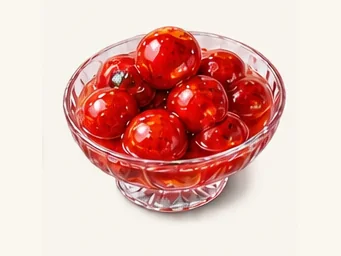
Chao hongguo (炒红果) is a Beijing-associated sweet of hawthorn fruit gently simmered with sugar and water. The fruit stays in recognizable pieces, with a glossy red finish and a sharp-sweet, soft bite; it is quite different from the brittle sugar shell on tanghulu.
Tap any red Chinese text to hear it in Mandarin.
What it is
The name literally suggests “fried red fruit,” but this sweet is generally simmered rather than fried in oil. It uses Chinese hawthorn—called 山楂 Shānzhā or 红果 Hóngguǒ—with sugar and water. Cooks commonly remove the stones first, then heat the fruit in syrup. The name and technique are not a fixed recipe: some cooks keep the fruit whole and tender, while longer cooking can soften or partly break it down.
Chao hongguo is a familiar Beijing-style traditional snack, but it is not a Beijing-only ingredient or a single standardized formula. Hawthorn appears in several local sweets. Do not mistake this syrup-cooked preparation for tanghulu (糖葫芦), where whole hawthorns are commonly skewered and coated in a hardened sugar shell.
What to expect in the bowl
Look for red to translucent ruby fruit with a clear, glossy syrup. Hawthorn’s own acidity remains prominent beneath the sugar, so the flavor reads as tart-sweet rather than simply candy-sweet. Gently cooked fruit can be tender and soft while still holding its shape; syrup thickens as fruit juices and pectin mingle with the sugar. Longer cooking, fruit variety, and the amount of water change whether the result is a spoonable syrup with intact pieces or a softer, more jam-like sweet.
It may be served chilled as a small sweet or a cold side dish. A home-cooking account recommends cooling the fruit and says chilling suits its flavor; a Beijing-food listing also describes it as a cold dish in restaurants. The exact serving style varies, so ask how a shop serves its batch.
How to order and eat it
Show the menu name 炒红果 (chǎo hóngguǒ). A simple question is 有炒红果吗? Yǒu chǎo hóngguǒ ma? — “Do you have chao hongguo?” It is usually eaten by spoon, taking fruit with a little syrup. If you prefer less sweetness, ask whether it is served with extra syrup on the side; shops may not be able to adjust a batch already prepared.
The stones are normally removed, but check the bowl before eating because preparation and serving practices vary. The fruit itself is strongly tart and often sweetened generously; choose a small portion if that balance is unfamiliar.
Where to eat it
You can find Chao hongguo all over Beijing, so there is no need to seek out one particular restaurant. To find one near you, search for “炒红果” in Meituan (美团) or Amap (高德地图) and check recent reviews, distance and opening hours.
More dishes to compare
Explore related local specialties and compare their names, preparation notes and ordering guidance.
Chaogan 炒肝 →
Pork intestines and pieces of liver cook in a glossy, starch-thickened broth with plenty of garlic. Despite the name, the finished dish is ladled into a bowl rather than served as a dry liver stir-fry. Expect soft offal, a gelatinous gravy and a pronounced garlic aroma. It is richly savory rather than delicately seasoned.
Sour-plum drink 酸梅汤 →
Smoked dried plums are simmered with sugar and ingredients such as hawthorn; recipes may also include licorice or dried citrus peel. The strained drink is usually cooled before serving. It combines smoky fruit, firm acidity and sweetness rather than tasting like ordinary fresh-plum juice. Different shops vary considerably in concentration and sugar.
Sources & reading
Recipes and servings vary between kitchens.