

Chengde Cold Starch Jelly 承德凉粉
Chengde liangfen is a cool, smooth mung-bean starch jelly associated with Chengde, Hebei. It is set, cut into fine strips, and dressed with sesame paste, vinegar, garlic, coriander and chilli oil; the exact seasoning and recipe can vary by vendor.
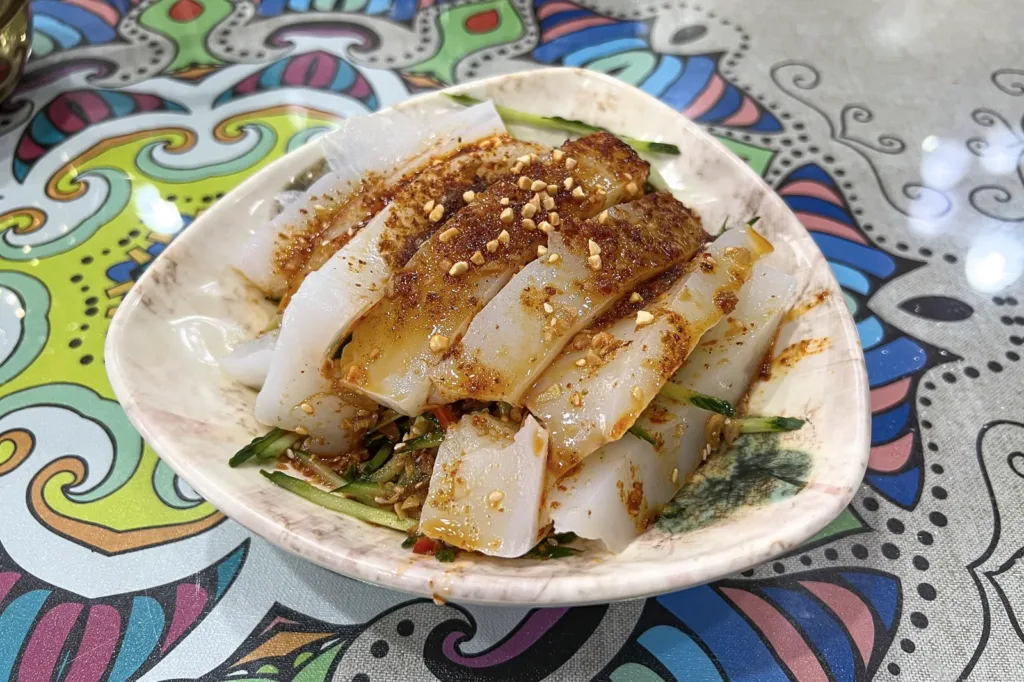
What you are ordering
承德凉粉 is a Chengde-associated cold starch snack, not a single nationwide recipe. A local Chengde tourism description lists mung-bean powder, white alum, sesame paste, sesame oil, coriander, vinegar and garlic, then describes a three-stage process of adding the ingredients, cooking the mixture and letting it set before cutting or pressing the jelly into strips.
The texture is the main point: smooth, cool and softly springy, with the sauce providing salt, acidity, sesame richness and, in some bowls, chilli heat. A local travel account describes people in the Chengde area eating liangfen for more than 300 years. Treat that as a local continuity claim rather than a precise, independently dated origin story.
A separate English food feature repeats a story that the Xianfeng Emperor once ate liangfen from a vendor outside the Mountain Resort. It presents the episode as a legend, not as proof of the dish’s invention. The same source notes that liangfen varies widely across China: pea, rice, mung-bean and potato starch may all be used, and the jelly may arrive as slices, cubes or noodles.
How to taste it
Look for the Chinese name 承德凉粉 on a menu or ask to see it written down. The local description is a useful guide to the Chengde style, but it is not a current standardized recipe. Ask what starch is used, whether the bowl contains chilli, what oil and sauce are included, and whether any stock or other seasoning has been added. The dish name alone does not establish that a serving is vegetarian, allergen-free or suitable for a particular diet.
Expect the set jelly to be cut into thin strips and mixed with its dressing shortly before eating. Sesame paste, vinegar, garlic and coriander are the recognizable flavour cues; heat and salt can vary. If you are comparing it with another regional liangfen, compare the starch and shape as well as the sauce rather than assuming every bowl called 凉粉 is the Chengde version.
Where to eat it
You can find Chengde Cold Starch Jelly all over Hebei, so there is no need to seek out one particular restaurant. To find one near you, search for “承德凉粉” in Meituan (美团) or Amap (高德地图) and check recent reviews, distance and opening hours.
More dishes to compare
Explore related local specialties and compare their names, preparation notes and ordering guidance.
Qizi shaobing 棋子烧饼 →
Small baked pastries identified with Tangshan's food streets and eastern Hebei food routes.
Zhaoxian Shita flatbread 赵县石塔烧饼 →
Small baked flatbreads are a recognised Zhaoxian specialty. Their toasted crust makes them a convenient snack while exploring town.
Xianghe meat-filled flatbread 香河肉饼 →
A large, thin flatbread encloses a generous layer of minced meat, then arrives cut into shareable wedges. It is a signature food of Xianghe in Hebei, east of Beijing.
Sources & reading
Image credits & notes (1)
- Liangfen at Moon Gülhan Restaurant in Beijing, shown as a general northern-Chinese liangfen example rather than a photograph of Chengde liangfen. Photo: N509FZPhoto: CC BY-SA 4.0