

Gu'an Stewed Pork Offal 固安炖吊子
Gu'an Stewed Pork Offal is featured among the local specialties of Hebei.
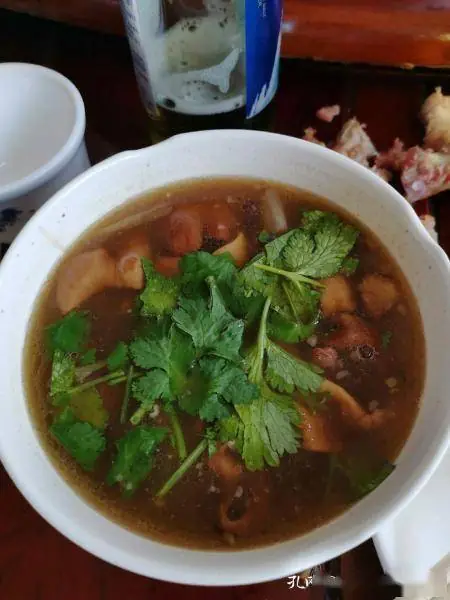
Image notes
Resized for the web; the photo itself has not been edited.
Gu'an Stewed Pork Offal (固安炖吊子) is a slow-simmered pot from Gu'an county in Langfang, Hebei, reported by Xinhua as a local tradition of more than two hundred years and served as something between a dish and a soup.
How it is made
The name leads with the method. 炖 is slow simmering in liquid, and that is the whole technique on show here: a long, unhurried cook in a covered pot, so that the contents soften and the broth thickens and takes on the flavour of whatever was simmered in it. The report frames the result as 亦菜亦汤, both a dish and a soup, which tells you the liquid is not discarded or reduced away — it arrives at the table as part of the order. What goes into the pot is deliberately not stated here, because the page saved for this batch does not list it. Ask the kitchen.
Flavour and texture
Two phrases in the source describe the target exactly. 鲜香浓郁 is the savoury depth that comes from a long simmer, and 肥而不腻 is the balance that matters more: richness without the greasy film that a badly handled stew leaves on the tongue. That balance is a cooking decision, not a property of the ingredients alone, which is why a dish built this way is judged by whether you want a second bowl. The finish is part of the flavour as well — coriander and fried chilli go over the pot, so a fresh herb note and a warm, aromatic heat sit on top of the slow-cooked base.
Where the dish belongs
Gu'an is a county of Langfang in Hebei, between Beijing and the corridor south towards Tianjin, and Xinhua (reproduced by The Paper) describes 炖吊子 as one of its traditional dishes, carried on for more than two centuries. The Xinhua-sourced item was published under a series on Hebei cooking, which places it in the regional repertoire rather than in any single restaurant's menu. The name travels with the county: 固安炖吊子 is how the dish is identified, and that prefix is the part worth remembering when you are looking for it on a menu.
Ingredients and dietary checks
Because the contents are not documented on the page saved here, this is a dish to order by asking questions rather than by reading a description. Start with 里面有什么 (what is in it) and 是什么肉 (what meat is it), then narrow down: 有内脏吗 (does it contain offal), 有猪肉吗 (does it contain pork), 辣不辣 (how spicy is it) and 香菜可以不放吗 (can you leave out the coriander). If you are avoiding gluten, ask what the pot is thickened or served with: 里面有面酱吗 (is there flour paste in it). 有没有汤里的味精 (is there MSG in the broth) covers the last common question.
How to order it
Order by the pot or bowl rather than by piece: 一份 (one portion) or 一碗 (one bowl) is what you want, and 小份 (small) is a reasonable way to try it first. Chili is a garnish here, so 不要辣 (no chilli) is a normal request and 少辣 (less chilli) is the middle ground. Ask 配米饭还是饼 (does it come with rice or flatbread) if you are planning the rest of the table, and 可以打包吗 (can you pack it to take away) if you want the broth to travel — a wet dish needs a container, so expect to be asked.
How to eat it
Treat it as a shared dish and a soup at once. Spoon some of the liquid over rice or tear flatbread into the bowl so it soaks up the broth, then eat the solid pieces with the garnish that was scattered on top. One portion splits comfortably between two people when other dishes are on the table, and a whole pot is a table-centre dish for four. It is rich food, so order one lighter vegetable plate alongside it rather than two more braises.
More dishes to compare
Explore related local specialties and compare their names, preparation notes and ordering guidance.
Baiyangdian Stewed Mixed Fish 白洋淀炖杂鱼 →
Baiyangdian Stewed Mixed Fish (白洋淀炖杂鱼) is the braise of Baiyangdian's lake country, where mixed catches go into one pot; Gu An Dun Diao Zi is the same 炖 method applied away from the water, in Gu'an county, so the difference is the pot's contents rather than the cooking.
Questions before you order
Is it a soup or a main dish?
Both, and that is the point: Xinhua (reproduced by The Paper) describes 炖吊子 as 亦菜亦汤. The broth is served with the solids, so order rice or flatbread to go with it and treat the liquid as part of the dish rather than something to leave behind.
What exactly is in the pot?
This entry does not name the ingredients, because neither the Xinhua report nor the Pengpai page saved for this batch lists them. Ask 里面有什么 (what is in it) and 是什么肉 (what meat is it) when you order, and check 有内脏吗 if offal is not what you are after.
Sources & reading
The supplied food list supports this name and regional association. The culinary terms below are explained as menu vocabulary; a local recipe, origin story and venue availability have not been independently verified.