

Botou Savoury Tofu Pudding 泊头老豆腐
Botou Savoury Tofu Pudding is featured among the local specialties of Hebei.
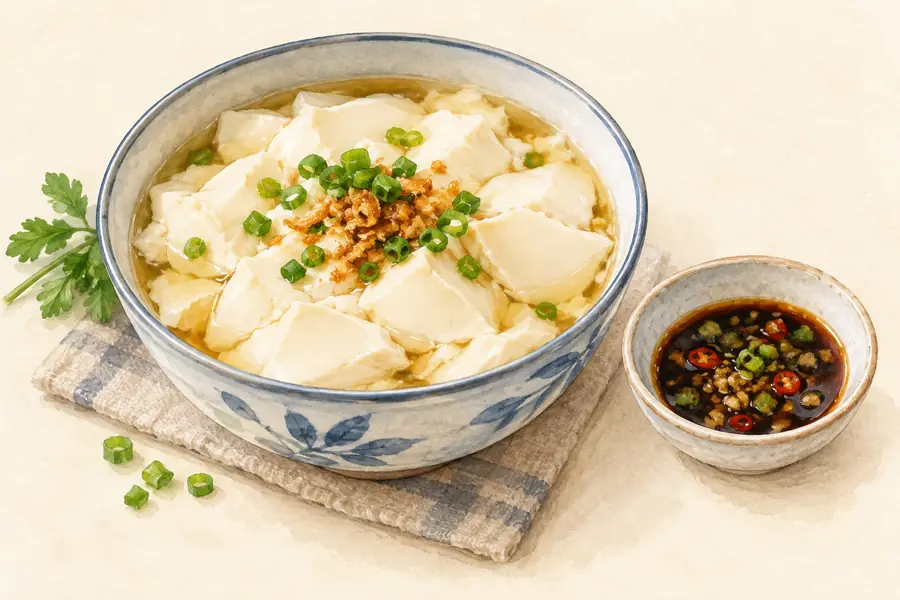
Botou Savoury Tofu Pudding (泊头老豆腐) is a Hebei bean-curd bowl from Botou in Cangzhou, where the curd is set with more care than a quick douhua and the real work goes into a broth simmered from several ingredients.
How it is made
The Cangzhou municipal food page defines the dish by contrast. 豆腐脑, it says, is the quick version, whereas 老豆腐 is made with more care so that the set curd itself is 上品 — the better product. The decisive difference, on the same page, lies in the liquid: a douhua bowl is usually finished with a little soy-sauce water, but the soup for 老豆腐 is 绝对讲究, genuinely particular, and is 精心熬制 from 好几味材料 — carefully simmered out of several ingredients into a proper broth.
Flavour and texture
Because the curd is described as made more deliberately than douhua, the bowl eats as a spoonable, slightly firmer bean curd sitting in a seasoned broth rather than as a loose custard, and the taste comes from the simmered soup rather than from the soy milk itself. Expect a savoury, gentle bowl in which the broth sets the direction and the curd carries it — not a sweet drink and not, at least as the city page tells it, a bowl defined by chilli heat.
Local roots
Botou is a county-level city in Cangzhou, in the canal country of eastern Hebei, and 泊头老豆腐 is presented on 沧州市人民政府's 魅力狮城–美食特产 column as one of the foods to eat in the city, listed alongside 黄骅烧饼, 粉饹馇, 沧州狮子头, 吴桥宫面 and 河间驴肉火烧. The Cangzhou municipal government frames the whole column as the city's answer to the visitor's question of what to eat, so the dish is placed as a local speciality of the place named in its title rather than as a generic breakfast item.
Ingredients and dietary checks
Soybeans and water make the curd, so soy runs through the whole bowl and anyone with a soy allergy should treat it as a hard stop. Beyond that, the source is explicit only that the soup brings 好几味材料 together without naming them, so the seasoning is genuinely per-kitchen. If you avoid meat or fish, ask how the broth was built rather than assuming: a savoury 老豆腐 soup can be simmered on animal stock. Wheat is not part of the dish itself, but the bread served on the side usually is.
How to order it
Show 泊头老豆腐 and ask the two questions the source raises: 汤是怎么熬的 (how was the broth made) and 是素的吗 (is it vegetarian). Practical extras are 一份多少钱 (what one portion costs), 要辣的吗 (with chilli or not) and 可以少放点盐吗 (less salt, please). If you are choosing between shops, ask which one makes its own 老豆腐 rather than pouring quick 豆腐脑, because the difference between the two is exactly what the dish's name is about.
How to eat it and plan a meal
Treat it as a bowl rather than a course: it fits breakfast or a light stop, eaten with a baked bread such as a 烧饼 for dipping and finished with a spoon to catch the last of the broth. Order one per person, add a plain bread each, and plan a main dish separately if you are building a full meal. Ask for the bowl hot and eat it before the curd cools and the broth loses its edge.
More dishes to compare
Explore related local specialties and compare their names, preparation notes and ordering guidance.
Tangshan Lazy Tofu with Greens 唐山懒豆腐 →
Tangshan Lazy Tofu with Greens (唐山懒豆腐) is the other bean-curd bowl recorded for the province in the same index: a looser, homestyle preparation of ground beans that is cooked and eaten rather than set and sliced. 泊头老豆腐 takes the opposite route — a deliberately made set curd whose effort sits in the simmered soup — which is exactly the distinction the Cangzhou municipal page draws against quick douhua.
Questions before you order
How is 泊头老豆腐 different from douhua?
The Cangzhou city page draws the line at both the curd and the liquid: 豆腐脑 is made quickly, while 老豆腐 is prepared with more care so the curd comes out 上品, and its soup is simmered from several ingredients instead of a splash of soy-sauce water.
What is actually in the soup?
The municipal food page says the broth is carefully simmered from several ingredients but does not name them, so the answer is shop-specific; ask 汤是怎么熬的 and whether the base is meat, and ask 是素的吗 if you need a vegetarian bowl.
Sources & reading
The supplied food list supports this name and regional association. The culinary terms below are explained as menu vocabulary; a local recipe, origin story and venue availability have not been independently verified.