

Peony Mock Bird's Nest Soup 牡丹燕菜
Peony Mock Bird's Nest Soup is featured among the local specialties of Henan.
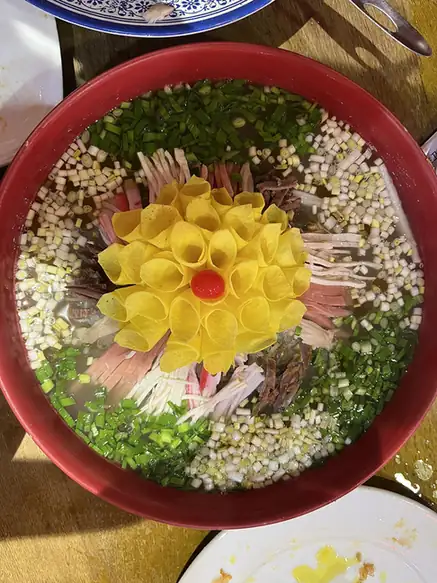

Photo adjustments
EXIF orientation normalized; resized without changing aspect ratio; converted to WebP. No subject edits.
Peony Mock Bird's Nest Soup (牡丹燕菜) is a dish of finely shredded radish served in stock, which a CCTV (央视网) programme page calls the most representative dish of the Luoyang water banquet (洛阳水席).
How it is made
The Henan tourism portal (河南旅游资讯网), carrying a Xinhua account, describes the radish dish as Luoyang yancai (洛阳燕菜). Radish is cut into fine shreds about one and a half cun (寸) long and soaked in cold water, then tossed with fine mung-bean starch and steamed for five minutes. The shreds are cooled, loosened in warm water, drained, sprinkled with salted water and steamed through again.
For serving, the shreds are cooked in a rich stock with shredded chicken, shredded pork, dried shrimp, shredded tendon, dried bamboo shoot (玉兰), squid, sea cucumber and laver, and finished with coriander and yellow chives.
Flavour and texture
The same account calls the flavour sour, hot, fresh and fragrant, in a style of its own, with a clear broth that is pleasant on the palate. The home-cooked version it describes uses radish, shredded meat, egg and coriander.
Where it comes from
The same account counts twenty-four dishes in the water banquet and puts Luoyang yancai first. The story told for its name is set more than 1,200 years ago under Empress Wu Zetian (武则天) of the Tang: a farmer in Luoyang's Dongguan (东关) grew an enormous radish and sent it to the palace, where the cooks prepared it with delicacies from mountain and sea. The empress found it like bird's nest and named it "mock bird's nest" (假燕菜); the dish then passed from the court to ordinary kitchens.
The Zhenbutong Luoyang water banquet craft (真不同洛阳水席制作技艺) entered China's national intangible cultural heritage list in 2008 as traditional craft item VIII-173, submitted by Luoyang, with the Luoyang Jiujia company (洛阳酒家有限责任公司) as its safeguarding body. The listing explains that the banquet takes its name from soup dishes served as main courses, traces its cooking techniques to the Eastern Zhou and its banquet format to the Tang, and notes a tradition of standing vegetables in for meat and making the imitation pass for the real thing.
More dishes to compare
Explore related local specialties and compare their names, preparation notes and ordering guidance.
Luoyang water banquet 洛阳水席 →
This is the first of the water banquet's twenty-four dishes, and the banquet's national heritage listing names the imitation of costly ingredients as one of its skills.
Sources & reading
Written from the linked sources and checked sentence by sentence against quoted extracts by a separate reviewer on 2026-09-24. Recipes and servings vary between kitchens.