

Xiaoyaozhen Hulatang Peppery Soup 逍遥镇胡辣汤
Xiaoyaozhen Hulatang Peppery Soup is featured among the local specialties of Henan.
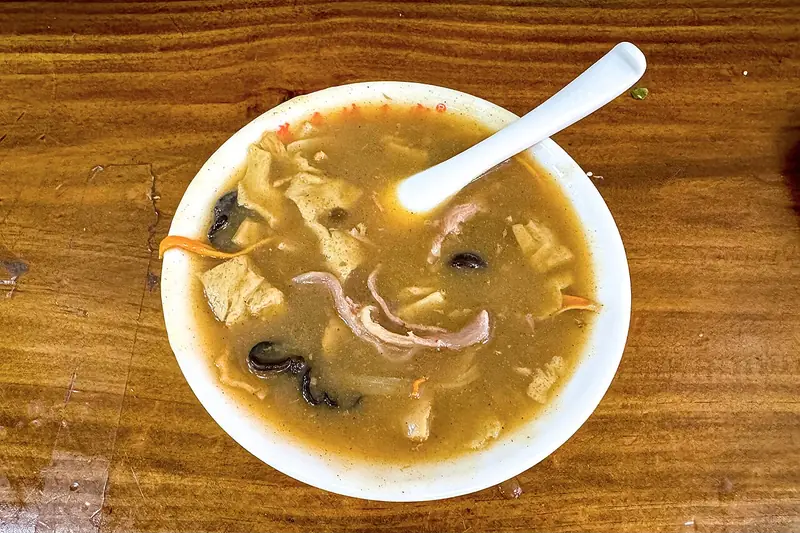
Xiaoyaozhen Hulatang Peppery Soup (逍遥镇胡辣汤) is the thick, pepper-hot soup of Xiaoyao (逍遥镇), a town in the southwest of Xihua County (西华县), Zhoukou (周口), in Henan. Economic Daily calls the town the birthplace of hulatang, and in 2021 the Xiaoyao hulatang-making technique was added to the national list of intangible cultural heritage, under traditional snack-making skills.
How it is made
According to the national heritage entry, the soup starts from a stock of beef bones, mutton and crucian carp, seasoned with more than 20 spices, and is cooked with beef and mutton, wheat gluten, starch noodles and daylilies. The ingredients go into the pot in set proportions and a set order, then simmer over low heat while being stirred slowly with a wooden spoon. China Daily notes that local Huaishan goat meat and daylilies were added over time, along with a flour thickening, and that makers adjust their blend of 30 medicinal herbs to the seasons, with more liquorice, hawthorn and tangerine peel in summer and more pepper, galangal and cinnamon in winter.
Economic Daily describes the method of Gao Qunsheng (高群生), a thirteenth-generation maker of the Gao family's soup: the stock is simmered from whole mutton bones for more than five hours. The gluten should be chewy, with no large holes. At the end the pot is heated around the rim so the soup rolls from the outside inward and does not separate.
How it is eaten
Served thick and reddish, the soup has a sharp pepper heat and comes with large pieces of beef and mutton, crunchy daylilies and springy gluten. It is dressed with small-mill sesame oil and aged vinegar and eaten with pan-fried buns (shuijianbao, 水煎包) or youmo (油馍), a fried flatbread. In Xiaoyao, shops ladle the soup with wooden spoons, and local people come in from about 5 to 8.30 in the morning.
Where it comes from
Citing the county annals, the heritage entry traces the recipe to the Ming dynasty: an imperial cook named Zhao Qi (赵杞) fled to Xiaoyao during the Jiajing reign and passed his formula to the neighbouring Gao and Wang families, whose lines have reached their fourteenth generation. China Daily gives a Song-dynasty version of the same story. Xiaoyao sits on the Sha River (沙河), and its growth as a river port for traders from north and south spread the soup's name.
Sources & reading
Written from the linked sources and fact-checked against them on 2026-09-24. Recipes and servings vary between kitchens.
Image credits & notes (1)
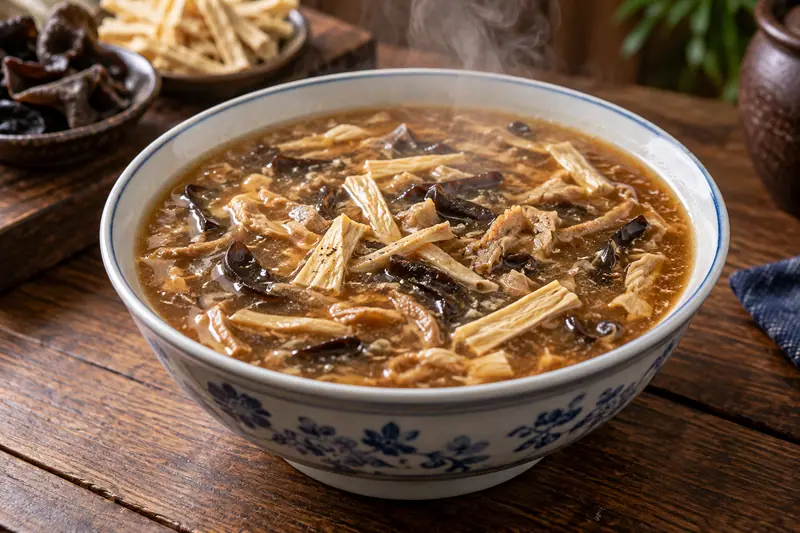
- Reference photo of a similar dish · 同类菜品参考照片A similar preparation is pictured; the local version may differ. 同类菜品参考照片,当地做法可能不同。Photo: Windmemories · CC BY-SA 4.0Resized for the web; the photo itself has not been edited. Thumbnails may show a cropped view.
